


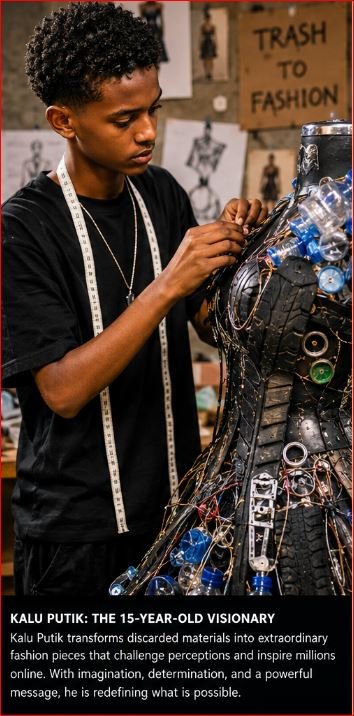
In recent years, the global fashion industry has increasingly turned its attention toward Africa, not only for inspiration, but for originality, storytelling, culture, and raw creative energy. Among the new generation of African talents now shaking the international fashion scene stands a remarkable young Ethiopian creator: Kalu Putik.
At only 15 years old, Kalu Putik has become one of the most talked-about young fashion sensations on social media, drawing millions of viewers with designs made from discarded materials such as plastic bottles, tires, cardboard, wires, old fabrics, and everyday waste. What many see as trash, Kalu transforms into artistic high-fashion statements.
Ethiopia: A Nation of History, Identity, and Creativity

To understand the emergence of a talent like Kalu Putik, one must first understand Ethiopia itself, one of Africa’s oldest civilizations and among the continent’s strongest symbols of cultural pride and resilience.
Ethiopia is globally recognized for its ancient history, unique identity, and rich artistic heritage. Unlike many African nations, Ethiopia was never fully colonized, which allowed it to preserve much of its traditional culture, language, architecture, music, and artistic expression. The country is also known as the birthplace of coffee and home to remarkable traditions in weaving, textile craftsmanship, jewelry, and ceremonial clothing.
Ethiopian fashion has long carried distinctive visual elements: handwoven cotton fabrics, colorful embroidery, tribal symbolism, and elegant silhouettes that blend royalty with simplicity. In recent decades, Ethiopian designers have increasingly entered global fashion conversations through modern interpretations of traditional African aesthetics.
Today, cities like Addis Ababa are becoming growing hubs for African creativity, art, music, film, and fashion innovation. The rise of digital media and social platforms has also allowed young Ethiopian creators to bypass traditional fashion gatekeepers and reach international audiences directly.
The Story Behind Kalu Putik
Known online through the handle “kaluputics,” Kalu Putik reportedly began posting videos in March 2026. Within weeks, his content exploded across Instagram and TikTok, attracting millions of views and followers from around the world.
What makes his work extraordinary is not simply the clothing itself, but the imagination behind it.
Without expensive studios, luxury materials, or formal fashion school training, Kalu creates dramatic runway-style looks using recycled objects found around his environment. His videos often begin with what appears to be ordinary waste materials, only to reveal highly creative sculptural outfits moments later.
Many viewers have compared his visual style to luxury fashion houses and avant-garde runway designers. Others praise his confidence, presentation, and ability to model his own creations with elegance and charisma.
International audiences were especially fascinated by the contrast between his modest surroundings and the sophistication of his designs. Rather than hiding his background, Kalu uses it as part of the visual storytelling, proving that creativity can rise from any environment.
His rapid rise reportedly attracted attention from celebrities, major fashion observers, and even social media platforms themselves.
Fashion Beyond Luxury
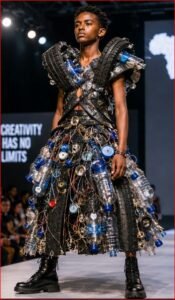
Kalu Putik represents something much deeper than viral entertainment.
For decades, the global fashion industry was largely controlled by luxury capitals such as Paris, Milan, London, and New York. Expensive brands, elite connections, and massive production budgets defined success. But the digital era is changing that structure rapidly.
Today, originality has become more valuable than perfection.
Young audiences increasingly admire authenticity, sustainability, and creative storytelling over expensive labels. Kalu Putik’s work perfectly captures this global shift.
His designs also enter the important conversation about sustainability and environmental responsibility. The global fashion industry produces millions of tons of textile waste every year, while enormous quantities of second-hand clothing and discarded materials end up polluting parts of Africa and other developing regions.
By transforming waste into wearable art, Kalu sends a powerful message without needing long speeches or political campaigns:
Innovation can come from limitation.
What Kalu Putik Means to the World
The rise of Kalu Putik symbolizes several important realities about the future:
1. Talent Can Come From Anywhere
The internet has changed the meaning of opportunity. A teenager in Ethiopia can now inspire audiences in Brazil, Nigeria, Europe, Asia, and America simultaneously.
2. Africa Is Becoming a Global Creative Force
African youth are increasingly shaping global conversations in fashion, music, sports, digital media, and entertainment. Kalu Putik joins a new generation, proving that Africa is not only a market, but it is also a creator of trends.
3. Creativity Is More Powerful Than Resources
One of the strongest lessons from Kalu’s story is that the lack of expensive tools should never stop talent. His journey shows young people that imagination and determination can overcome financial limitations.
4. Sustainability Is the Future of Fashion
The future fashion industry will increasingly value recycling, environmental responsibility, and alternative materials. Kalu’s work naturally aligns with that direction.
Inspiration for Young Talents Worldwide
For young dreamers across Africa, Latin America, and the developing world, Kalu Putik’s story carries an important message:
Do not wait for perfect conditions before beginning.
Many successful creators started from difficult environments, limited resources, or places the world ignored. What separates them is vision, persistence, and the courage to create differently.
Kalu Putik may still be only 15 years old, but he has already shown the world something powerful:
Greatness does not depend on where you start; it depends on how boldly you imagine.
And perhaps that is why the world has stopped scrolling to watch him.






Leave feedback about this