


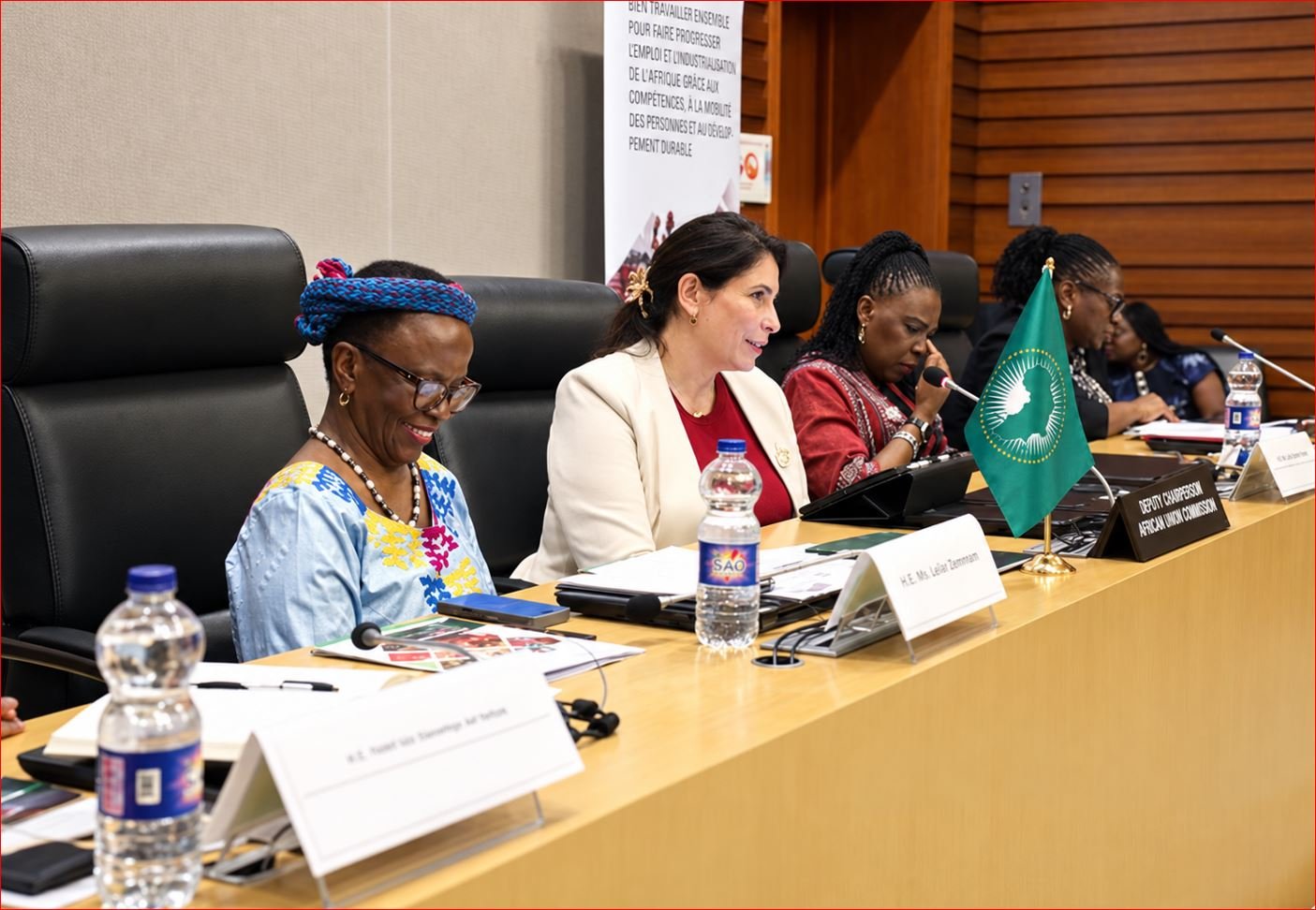
At a high-level meeting during UNGA 81 in New York, African and international leaders called for women to have real authority in negotiations, ceasefire monitoring, and post-conflict reconstruction, not ceremonial seats without influence.
Peace, Security & Women’s Leadership
By I. E. Aroh – Afribraz Global Business Magazine
New York | September 2026
For millions of Africans who have heard decades of declarations about peace, equality, and inclusion, another high-level meeting may not, by itself, signal change. The real test is whether the decisions made in New York will be visible in the communities living with violence, displacement, and economic destruction.
That question stood at the center of a high-level meeting on Women, Peace and Security convened by the African Union on the margins of the 81st Session of the United Nations General Assembly, which opened in New York on 8 September 2026. The UN’s general debate is scheduled for 22–28 September.
The meeting brought together Her Majesty Queen Mathilde of Belgium; Mahmoud Ali Youssouf, Chairperson of the African Union Commission; UN Deputy Secretary-General Amina J. Mohammed; Prof. François Havyarimana, Burundi’s Minister of National Education and Scientific Research; women mediators, diplomats, foreign ministers, and special envoys.
Moderated by Ambassador Liberata Mulamula, the African Union Special Envoy on Women, Peace and Security, the discussion focused on one urgent objective: ensuring that women participate fully, equally, and meaningfully in efforts to find a political solution to the crisis in eastern Democratic Republic of the Congo.
Women are carrying the crisis but remain outside decision-making
Women and girls are among the most severely affected by armed conflict in eastern DRC. They face displacement, loss of livelihoods, disrupted education and healthcare, family separation, sexual violence, and exploitation.
UN Women has repeatedly warned that the escalating conflict in the DRC has intensified sexual and gender-based violence against women and girls.
Yet women are not merely victims waiting to be protected. Across conflict-affected communities, they manage households, organize humanitarian assistance, mediate local disputes, preserve community networks, and help rebuild trust between divided populations.
Queen Mathilde emphasized this indispensable role, describing women as agents of peace, community leaders, and builders of trust. Her intervention reinforced a principle too often ignored during formal negotiations: those who experience conflict at the community level possess knowledge that cannot be replaced by discussions conducted exclusively among political and military leaders.
A peace agreement negotiated without women may end fighting on paper while failing to address the conditions that allow violence to return.
From symbolic representation to decision-making authority
African Union Commission Chairperson Mahmoud Ali Youssouf reaffirmed the AU’s commitment to the Women, Peace and Security agenda under Agenda 2063, UN Security Council Resolution 1325, the Maputo Protocol, and the Continental Plan of Action.
His central message was that women’s participation must be substantive and present throughout the peace process—not peripheral, occasional, or symbolic.
This means women must have the authority to influence:
- Peace negotiations and mediation teams;
- Ceasefire monitoring and verification mechanisms;
- Humanitarian and community-recovery programs;
- Institutions implementing peace agreements;
- Natural-resource governance and local development;
- Post-conflict justice and reconciliation;
- Monitoring commitments made by governments and armed actors.
Including women in an official photograph or conference delegation is not enough. Meaningful participation requires speaking rights, access to information, negotiating authority, institutional protection, and resources to keep working after international meetings end.
What would make change visible to African people?
For ordinary Africans to believe that something is genuinely changing for the better, the results must be visible beyond diplomatic halls.
The first sign would be women from affected Congolese communities receiving formal seats at negotiations and ceasefire bodies. Their participation should include local peacebuilders, survivors’ representatives, traditional leaders, legal experts, entrepreneurs, youth leaders, and civil-society organizations, not only prominent political figures.
Second, dedicated funding must reach women-led organizations operating in conflict zones. International commitments will have limited credibility if community mediators continue to work without transport, security, communications equipment, legal assistance, or reliable financing.
Third, women should be included in mechanisms that monitor ceasefires and investigate violations. Communities need trusted representatives who can safely report attacks, forced displacement, sexual violence, and the recruitment of children.
Fourth, peace initiatives must deliver improvements families can recognize: safer roads and markets, reopened schools and clinics, restored agricultural activity, justice for survivors, and the secure return of displaced people.
Finally, progress must be publicly measured. The African Union and its partners should report how many women are included in negotiations, what responsibilities they hold, how much funding reaches women-led organizations, and whether peace agreements incorporate their recommendations.
These indicators can turn an international declaration into evidence of change.
Peace, natural resources and economic recovery
Chairperson Youssouf also highlighted the structural drivers of conflict, including inequality, exclusion and the exploitation of natural resources.
This connection is critical. The DRC possesses exceptional mineral, agricultural, hydroelectric and environmental resources, including major deposits of cobalt and copper. Yet natural wealth has not automatically produced security or shared prosperity for its population.
A sustainable settlement must therefore go beyond the suspension of hostilities. It must confront illegal resource exploitation, corruption, unemployment and the exclusion of local communities from economic decisions.
Women must be involved in this economic dimension of peace. When they participate in land governance, agriculture, cross-border trade, cooperatives, public procurement and reconstruction programs, peace becomes linked to household income and community stability.
This is also where the private sector has responsibilities. Businesses and investors operating in mineral-rich or conflict-affected regions must conduct rigorous human-rights due diligence, examine their supply chains and ensure that commercial activities do not finance armed violence or deepen local exclusion.
Supporting women mediators and civil society
The AU chairperson called for stronger support for women mediators and civil-society organizations, along with dedicated resources to enable women’s participation in implementing and monitoring peace processes.
The meeting also welcomed the 2026 – 2028 Strategic Plan of the Office of the AU Special Envoy on Women, Peace and Security. Its success will ultimately depend on whether it sets measurable targets, secures reliable financing and ensures transparent reporting.
UN Deputy Secretary-General Amina J. Mohammed reaffirmed the United Nations’ commitment to working with the African Union, the European Union and other partners. She stressed that women must not only be present at the negotiating table; they must be able to shape decisions and outcomes.
Representing Burundian President Évariste Ndayishimiye, Prof. François Havyarimana reaffirmed Burundi’s support for women’s leadership in conflict prevention and peacebuilding. He also highlighted the importance of linking the Women, Peace and Security agenda with the Youth, Peace and Security framework.
That connection reflects Africa’s demographic reality. Sustainable peace cannot be built while women and young people, two of the continent’s most important social forces, remain outside the institutions that determine their future.
The meeting also recognized Burundi’s First Lady, Angeline Ndayishimiye, for her contributions to women’s empowerment and the Women, Peace and Security agenda.
A turning point, or another promise?
The New York meeting delivered a clear message: sustainable peace in the Great Lakes region requires women’s structural participation in mediation, negotiation, implementation, monitoring, and verification.
However, Africans have seen many declarations that failed to change conditions on the ground. This initiative will be judged not by who attended the meeting, but by what follows.
Will Congolese women receive decision-making roles in peace negotiations? Will local organizations receive direct, timely funding? Will women help monitor ceasefires and resource governance? Will survivors obtain protection, justice, and economic opportunities? Will governments publish measurable results?
If the answer to these questions is yes, African communities will see evidence of change.
Women’s participation is not a favor to be granted after major political decisions are made. It is a strategic requirement for credible agreements, stronger institutions, and lasting peace.
For eastern DRC, and for Africa as a whole, the moment has come to move from promises of inclusion to demonstrable power, measurable responsibility, and visible results.



Leave feedback about this