


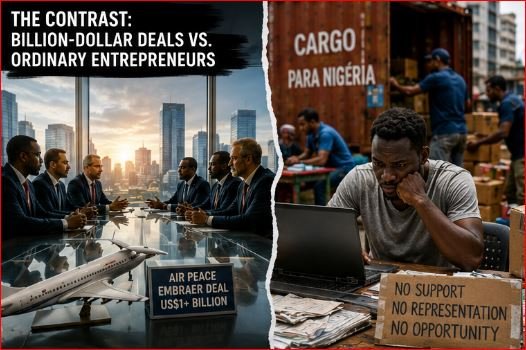
For decades, Nigeria and Brazil have proudly described themselves as strategic partners across the Atlantic. Diplomats speak of “historic ties,” governments announce billion-dollar trade relations, and multinational corporations celebrate deals involving aviation, energy, agriculture, fertilizers, mining, and industrial cooperation.
On paper, the relationship between Africa’s largest population and Latin America’s largest economy should be one of the strongest South–South economic partnerships in the modern world.
But beneath the official speeches lies a painful reality rarely discussed openly:
The ordinary Nigerian entrepreneur, the diaspora trader, the medium-scale importer, the young innovator, and the small business owner have largely been excluded from the Nigeria–Brazil economic bridge.
The truth is uncomfortable:
The Nigeria–Brazil relationship has become heavily dominated by governments, billionaires, politically connected corporations, and elite business groups, while the very people who actually sustain both economies, small and medium businesses, remain almost invisible.
This is the untold story.
This is the reality that many people living between Nigeria and Brazil already know.
And this is why many young entrepreneurs increasingly feel abandoned by the system that claims to represent them.
Two Giant Nations With Natural Economic Connections
Nigeria and Brazil are naturally connected in ways few countries in the world are.
Both nations share:
- Massive populations,
- Strong African cultural heritage,
- Large youth populations,
- Agricultural strength,
- Energy resources,
- Entertainment industries,
- Sports influence,
- Expanding technology sectors,
- And strong diaspora connections.
Diplomatic relations between both countries officially date back to 1961, while cultural ties go back centuries through Afro-Brazilian history and the transatlantic era.
Today, Brazil maintains an embassy in Abuja and a consulate-general in Lagos, while Nigeria maintains an embassy in Brasília.
Yet despite this long relationship, many Nigerians in Brazil still ask a difficult question:
Where exactly are ordinary Nigerians represented inside this partnership?
The Billionaire Economy Dominates the Bridge
One of the clearest examples of elite-dominated business relations is aviation cooperation.
Nigerian airline Air Peace became a major customer of Brazilian aircraft manufacturer Embraer, ordering dozens of aircraft worth well over US$1 billion over time.
The partnership became even more symbolic after the announcement of direct Lagos–São Paulo flights under bilateral agreements signed during high-level diplomatic engagements between Nigeria and Brazil.
This development is historic:
- Faster travel,
- Reduced cargo transit times,
- Improved diplomatic relations,
- Easier business mobility,
- And stronger South Atlantic cooperation.
But another question immediately arises:
How many ordinary Nigerians in Brazil were included in this ecosystem?
How many Nigerian-owned logistics companies in São Paulo benefited?
How many diaspora travel operators, freight consolidators, technology startups, interpreters, consultants, or youth entrepreneurs became part of the supply chain?
Very little evidence suggests broad grassroots inclusion.
The same pattern appears in:
- fertilizer cooperation,
- agricultural imports,
- industrial machinery,
- energy negotiations,
- oil partnerships,
- and commodity trade.
Large corporations dominate.
Ordinary entrepreneurs watch from the sidelines.
Dangote, Fertilizers, and Industrial Trade
Large Nigerian corporations continue to maintain significant commercial interactions involving Brazil’s industrial and agricultural sectors.
Nigeria imports:
- sugar,
- machinery,
- aviation equipment,
- food products,
- industrial inputs,
- and agricultural technology from Brazil.
Meanwhile, Nigeria exports:
- crude oil,
- urea,
- fertilizers,
- and mineral products.
Companies linked to sectors involving:
- Dangote Group,
- fertilizer production,
- petrochemicals,
- aviation,
- and industrial trade
continue to shape much of the visible commercial relationship.
Yet the average Nigerian entrepreneur is trying to:
- export/import food products,
- import Brazilian machinery,
- establish trade representation,
- connect with Brazilian manufacturers,
- or access financing,
often faces enormous barriers with little or no institutional support.
The Nigerians in Brazil Nobody Talks About
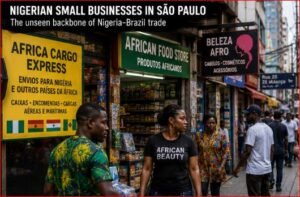
Perhaps the biggest contradiction in Nigeria – Brazil relations is the condition of Nigerians living in Brazil.
São Paulo is the economic heart of Latin America and one of the largest commercial cities in the world.
Thousands of Nigerians live, study, and do business there.
Many operate in:
- import and export,
- beauty products,
- African food distribution,
- fashion,
- tourism,
- logistics,
- cargo handling,
- entertainment,
- sports,
- education consulting,
- and technology-related activities.
Yet despite this reality, Nigeria still does not maintain a consulate in São Paulo.
For many diaspora Nigerians, this absence feels deeply symbolic.
A city with one of the largest concentrations of Nigerians in Latin America remains without direct Nigerian consular representation.
Many ask:
How can a country claim a strategic partnership with Brazil while neglecting its own citizens in the continent’s largest business city?
This lack of institutional presence creates practical difficulties involving:
- documentation,
- passport services,
- commercial support,
- legal orientation,
- business networking,
- emergency assistance,
- and trade facilitation.
Many diaspora entrepreneurs feel completely disconnected from Nigerian government structures.
Small Businesses Are the Real Economy
The irony is that small and medium enterprises are actually the backbone of both Nigeria and Brazil.
In Nigeria, SMEs contribute close to half of the GDP and account for the majority of employment opportunities.
Brazil’s economy is similarly sustained by millions of micro and small enterprises spread across:
- retail,
- agriculture,
- food production,
- fashion,
- services,
- transportation,
- and technology.
In reality, economies are not sustained only by billionaires.
They are sustained by:
- market women,
- cargo agents,
- online vendors,
- small importers,
- delivery operators,
- tailors,
- software developers,
- mechanics,
- restaurant owners,
- tourism agents,
- content creators,
- and diaspora traders.
Yet these are the people least represented in bilateral economic planning.
The Youth Feel Invisible
Young Nigerians increasingly feel disconnected from government-led international business structures.
Many young entrepreneurs want opportunities in:
- technology,
- digital commerce,
- AI,
- agriculture,
- sports management,
- entertainment,
- tourism,
- renewable energy,
- fashion,
- and international trade.
Brazil possesses enormous expertise and market opportunities in many of these sectors.
But access remains limited to a privileged few.
For many young Nigerians abroad, the perception is becoming dangerous:
“You matter only after becoming rich or politically connected.”
This feeling of exclusion risks creating long-term distrust between the youth and public institutions.
Why the Current Model Is Dangerous
A relationship controlled only by:
- governments,
- billionaires,
- and elite corporations
can never fully transform society.
Without grassroots inclusion:
- Unemployment remains high,
- youth migration increases,
- informal trade expands,
- diaspora frustration deepens,
- and economic inequality widens.
The Nigeria–Brazil relationship risks becoming another elite diplomatic project disconnected from ordinary people.
How Can This Be Fixed?
The solution is not to attack large corporations.
Big business remains important for:
- infrastructure,
- industrialization,
- aviation,
- manufacturing,
- and energy development.
But the relationship must become inclusive.
-
Open a Nigerian Consulate in São Paulo
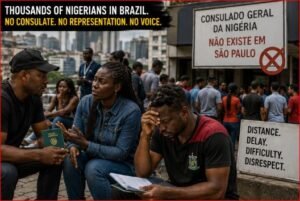
This is long overdue.
A Nigerian consulate in São Paulo would:
- support diaspora communities,
- facilitate business relations,
- improve documentation services,
- strengthen commercial diplomacy,
- and recognize the importance of Nigerians in Brazil.
-
Create Nigeria–Brazil SME Trade Missions
Trade delegations should not include only billionaires and political elites.
They must include:
- startups,
- women-owned businesses,
- youth entrepreneurs,
- diaspora traders,
- agro-processors,
- creatives,
- and technology innovators.
-
Build a Diaspora Business Database
Nigeria currently lacks a strong commercial mapping of its diaspora businesses in Brazil.
Government agencies should identify:
- who the entrepreneurs are,
- which sectors they operate in,
- what challenges they face,
- and how they can contribute nationally.
-
Improve Financing Access
Young entrepreneurs need:
- export financing,
- easier banking systems,
- affordable logistics,
- trade insurance,
- and institutional guidance.
-
Make Bilateral Trade Transparent
Governments should publish clearer trade reports showing:
- sector participation,
- SME involvement,
- diaspora contributions,
- and measurable economic impacts.
-
Institutionalize Youth Participation
Young professionals and diaspora innovators should be integrated into:
- trade councils,
- diplomatic forums,
- business chambers,
- and bilateral cooperation mechanisms.
Beyond Political Speeches
Nigeria and Brazil possess one of the most naturally strategic relationships in the Global South.
But if ordinary people remain excluded, the partnership will continue benefiting only a narrow circle of elites.
The future of Nigeria–Brazil relations will not be built only in presidential meetings or billion-dollar boardrooms.
It will also be built:
- in the streets of São Paulo,
- inside Lagos markets,
- within diaspora communities,
- among technology startups,
- in football academies,
- in cargo offices,
- in restaurants,
- in cultural centers,
- and among young entrepreneurs trying to create opportunities across both sides of the Atlantic.
Until these ordinary businesspeople are genuinely recognized, represented, and integrated into policy, Nigeria – Brazil economic relations may continue sounding impressive internationally while remaining incomplete socially.
And perhaps that is the most important question both governments must answer:
How can two giant nations speak so loudly about partnership while so many of their own people remain invisible?




Leave feedback about this