


Agriculture, Innovation & Food Security.
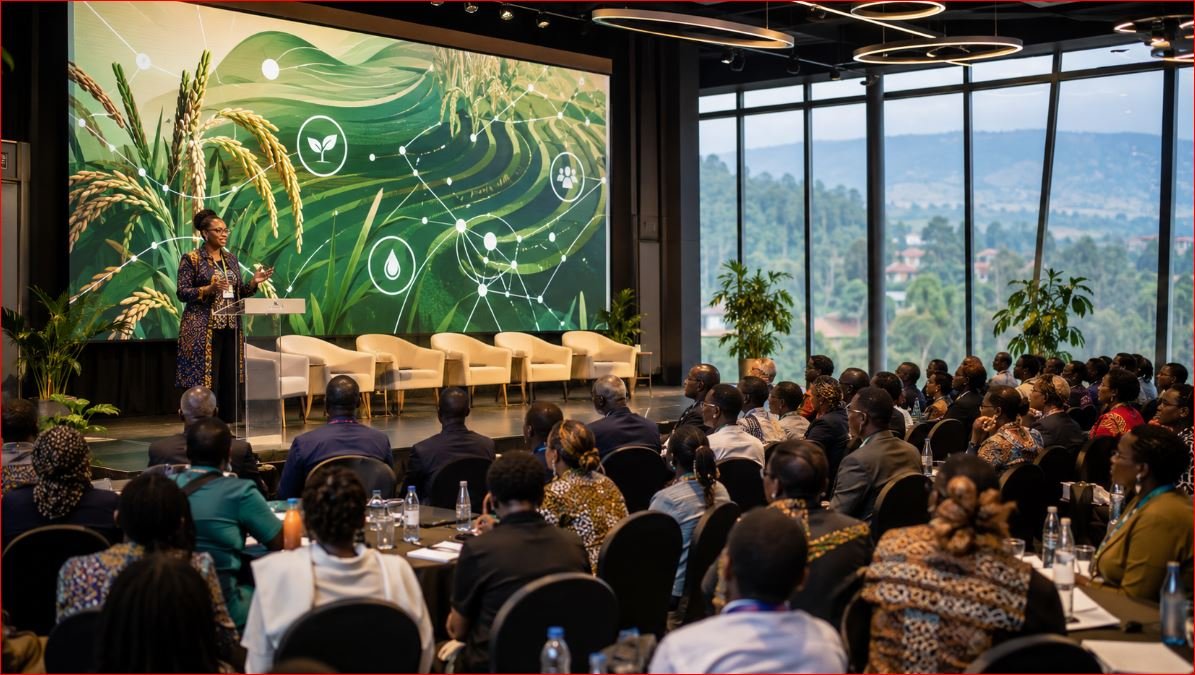
CGIAR is also developing a more integrated approach at the Africa Food Systems Forum 2026 in Kigali to translate agricultural research into reliable, profitable farming systems.
By IEAroh – Afribraz Global Business Magazine.
KIGALI, Rwanda – 31 August 2026.
Across Africa, agricultural science has developed crop varieties, digital tools, climate-smart practices, and new strategies to protect soil, water, and plant health. Yet one big question has persisted for years: how can we take these innovations to farmers faster, work together more effectively, bring them to the field, and achieve tangible improvements in income, productivity, and resilience? CGIAR will answer that question on August 31, 2026, when it presents the next chapter of its Sustainable Farming Program in Kigali, on the eve of the Africa Food Systems Forum 2026.
The pre-forum event will run from 4:30 p.m. to 9:30 p.m. at Mövenpick Hotel Kigali’s Inyange Hall and will bring together scientists, policymakers, development partners, and agricultural leaders to discuss how that research can be turned into practical solutions for farmers. “It’s at a crucial moment,” he said.
The 20th Africa Food Systems Forum will be held in Kigali from 1 to 4 September 2026, following pre-summit activities starting on August 31. Under the theme “Investing in Africa’s Agri-Food Systems: Nourishing Nations, Growing Jobs, Building Resilience,” the Forum is expected to bring together more than 5,000 people from over 50 countries.
From Separate Innovations to Integrated Solutions.
CGIAR’s updated Sustainable Farming Program is not a brand-new initiative; it is a more refined research structure for 2026-2030 that aims to better integrate different areas of agricultural science and accelerate the transfer of data from laboratories to pilot projects and into farmers’ fields.
The structure is organized around five interconnected areas of work:
- Advancing farm advisory on the front lines with AI-enabled farm advice at scale, using digital and artificial intelligence tools to help farmers make accurate, targeted, and inclusive recommendations.
- Adapting to and responding to new shocks, such as droughts, floods, pests, diseases, and other climate-related or biological threats.
- Delivering informed solutions to farm-level issues by connecting soil health and plant health, water management, access to inputs, economics, and social inclusion.
- Incubating sustainable farming innovations so promising technologies and ideas can be tested, improved, and expanded.
- Accelerating impact with reliable data, monitoring, evaluation, partnerships, and evidence needed to inform policy and scale up successful interventions.
Together, these areas show that farmers’ issues are no longer treated as isolated problems.
A farmer experiencing declining yields will also be dealing with poor soil, irregular rainfall, crop disease, high fertilizer prices, limited market access, and inadequate extension services. A new seed variety or digital application alone won’t be enough.
So the program aims to bridge scientific, economic, and institutional solutions to the reality of individual farming systems in the field. CGIAR says that its integrated farm-management approach will lead to 15–30% higher agricultural productivity, 10–15% higher farm profitability, 15% lower greenhouse gas emissions, and 20% more efficient use of water and fertilizer. Women and young people are key to the development and delivery of these solutions.
AfricaRice brings policy and impact expertise.
The Africa Rice Center (or AfricaRice for short) is part of the Kigali conversation and has a history of rice research, value-chain development, agricultural policy, and impact assessment. The organization’s representative is Dr. Aminou Arouna, an impact assessment economist and Director of AfricaRice’s Policy, Innovation Systems and Impact Assessment Program.
His involvement is significant because agricultural transformation cannot be measured solely by how many technologies are developed or how many projects are launched. It must be assessed by how farmers’ productivity, profitability, food security, and quality of life have changed.
Dr. Arouna’s research has focused on contract farming, agricultural value chains, digital extension services, and the economic development of farming interventions. He received the Quality of Research Discovery Award from the Agricultural & Applied Economics Association in 2022 for work on contract farming and rural transformation in Benin.
His work aligns with a basic principle: good agricultural programs need evidence that they work, for whom, and under what conditions.
That evidence is especially important when governments, development institutions, and private investors are deciding where to allocate scarce resources.
- How Agricultural Innovation, Science, and Biofuels Are Reshaping the Global Economy
- From Fufu to Jollof: São Paulo’s Growing African Food Scene
- The Food Crisis On Our Menu
Farmers can be partners, not just recipients.
The main message of the Sustainable Farming Program is that farmers shouldn’t simply be the recipients of scientific products.
They should be responsible for finding and implementing solutions, and for determining whether an innovation is feasible in their economy, environment, and culture. A technology may work in a controlled environment but fail in the farming community because it is too expensive, doesn’t provide the necessary inputs, or doesn’t fit local labor, market, or dietary conditions. Farmer-centered research can help fill that gap. It fosters a relationship between scientists and those who know the land through daily practice, so that technical knowledge and the hands-on experience of people in the land are combined. CGIAR’s approach also relies on partnerships with national agricultural research and extension systems, governments, universities, private companies, civil society organizations, and development partners. Such cooperation is needed to take innovation from pilot projects to widespread use by everyone on the ground.
Science Must Meet Finance and Markets.
The Kigali gathering is much more than agricultural research. It also highlights the relationship among science, investment, and market access.
Africa is not short on ideas. Scientists and entrepreneurs across the continent are developing better seeds, irrigation systems, farm management platforms, processing equipment, and climate-resilient practices. The challenge will be securing financing, distribution, and long-term institutional support. That is why the wider AFS Forum 2026 program focuses on investment and finance, food security and nutrition, climate resilience, youth and digital innovation, and regional trade and value chains. For farmers, increased production is only economically viable when they have reliable buyers, storage facilities, transport networks, processing capacity, and fair prices. Scientific progress is only possible if it is closely linked to a functioning value chain.
Rice is a perfect example. Yields are rising in Africa, and demand is always high, so producing more rice is important, but production alone can’t succeed in a competitive rice economy. Investment is also needed in harvesting, milling, storage, packaging, transportation, quality standards, and marketing.
Research by AfricaRice has repeatedly shown that action at every level of the value chain can increase productivity, improve food security, and create rural employment.
Brazil–Africa cooperation is also a possibility.
The Sustainable Farming Program also creates opportunities for Brazil and Africa to partner. Brazil has extensive experience in tropical agriculture, agricultural machinery, bioenergy, soil management, digital farming, crop research, and farmer cooperatives.
African countries, in contrast, have significant agricultural potential and emerging consumer markets that can drive innovation in the food sector. Working with Brazilian institutions and African governments, research centers, universities, and agribusinesses could support technology adaptation, training, equipment supply, joint research, and investment in food processing to grow and develop the food industry. But cooperation needs to meet local African needs. Technologies developed for Brazilian farms can’t simply be transferred without considering farm size, climate, infrastructure, financing, and local production systems. The most successful partnerships will pair Brazilian knowledge and African experience with local knowledge and farmer participation.
Turning Knowledge Into Work.
As delegates head to Kigali, the challenge is not just to produce more agricultural knowledge. It is to organize that knowledge around results farmers can see and sustain. For smallholders, impact means healthier soil, lower production risks, better access to information, reduced input costs, higher yields, and a reliable market for their produce. It’s also about earning enough from farming to support a family, educate children, and reinvest in the next farming season. CGIAR’s new Sustainable Farming Program is a promising framework for making this possible. But its success is not only in the conference halls but also on farms, in rural communities, and in the markets that connect African producers to consumers.




Leave feedback about this