


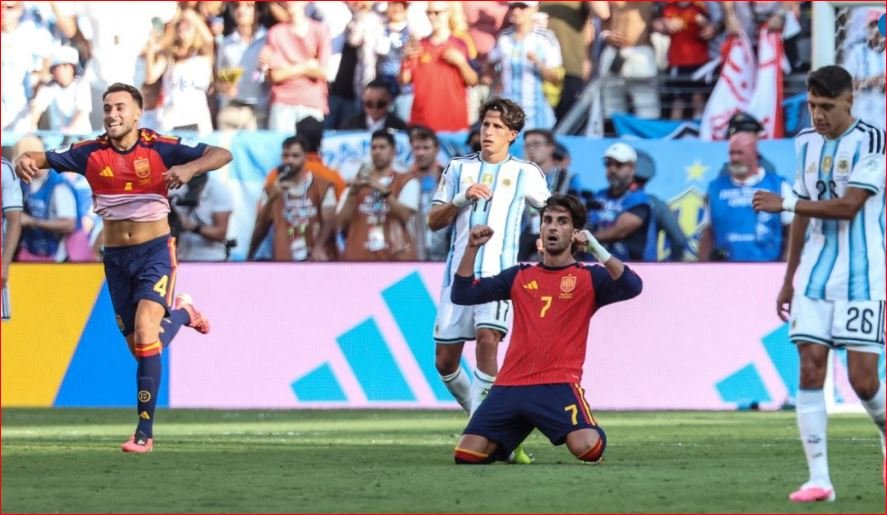
Spain defeats Argentina in a dramatic final as the record-breaking 2026 FIFA World Cup closes with music, celebrities, world leaders, and a symbolic handover to Brazil 2027.
An Exclusive World Cup Review by Afribraz Global Business Magazine.
For 39 unforgettable days, football’s attention was everywhere, from the opening in Mexico City on June 11 to the final trophy lifting in New Jersey on July 19, 2026 FIFA World Cup:
From the opening in Mexico City on June 11 to the final trophy lifting in New Jersey on July 19, 2026, the 2026 FIFA World Cup was a historic mix of excellence, cultural expression, commercial power, political significance, and human emotion.
Co-hosted by Canada, Mexico and the United States, the tournament was the first men’s World Cup to have 48 national teams to host 48 teams in the event. It produced 104 games in 16 host cities and was the largest and most geographically wide World Cup in football history. FIFA. By the time the final whistle was blown, Spain had won the World Cup for the second time, Argentina had surrendered its title after a fightback, African football had scored the best collective performance since the World Cup started, and sport, entertainment, diplomacy, and international business had all been merged into one.
A Spectacular Start in Mexico.
The World Cup began at the historic Mexico City Stadium, where Mexico played South Africa in the opening game. And it was the host country that made the first whistle play in a very colorful celebration of Mexican identity, Indigenous heritage, dance, and modern entertainment.
A parade of flags from all 48 countries in the tournament signaled the monumental scope of the event.
The musical entertainment was Shakira and Nigerian superstar Burna Boy, who performed the official tournament song “Dai Dai.” Alejandro Fernández, Belinda, Danny Ocean, J Balvin, Lila Downs, Los Ángeles Azules, Maná, Tyla and Ryan Castro were also involved in the opening celebrations.
Canada and the United States also held their own opening ceremonies in the same way, as this tournament is held in three countries. And Mexico’s 2 – 0 victory against South Africa was a perfect start for the hosts.
The United States also got things going well and beat Paraguay 4-1, while Canada drew Bosnia and Herzegovina.
The Largest World Cup in History.
The expanded competition was more than a World Cup. More countries were involved, new footballing nations were introduced to the world, and fans toured across a vast network of cities from Mexico and Canada to the east and west coasts of the USA. 72 group-stage matches were played in the expanded format, and there was another round of 32, round of 16, quarter-finals, semi-finals, third-place game, and final. According to the final numbers, an estimated 6.81 million fans attended the 104 games, an all-time World Cup attendance record. The competition produced 308 goals, on average three goals per match. In the group stage alone, 4.6 million fans came to the stadiums and FIFA Fan Festivals were held in the host cities. FIFA.
The tournament showed how the World Cup has become more than a football tournament. Airlines, hotels, restaurants, tourism operators, media companies, technology providers, retailers and small businesses were all helped by teams and fans moving around. At the same time, high ticket prices, security challenges, immigration and the long distance between host cities raised questions about accessibility and the growing commercialization of the most popular sport in the world.
Africa’s historic World Cup.
For Africa, the 2026 World Cup was an historic moment.
Ten African teams were involved: Algeria, Cabo Verde, Côte d’Ivoire, Democratic Republic of Congo, Egypt, Ghana, Morocco, Senegal, South Africa, Tunisia. Nine of the countries made it out of the group stage and reached the knockout stage. It is the greatest collective performance by African nations at a men’s World Cup. Morocco once again took African expectations furthest. The Atlas Lions defeated the Netherlands on penalties in the Round of 32 and Canada 3-0 in the Round of 16. They finished in the quarter-finals with a 2–0 loss to France. Egypt also made a mark and advanced through a penalty shootout against Australia before losing 3-2 against Argentina in the Round of 16. Senegal, Ghana, Côte d’Ivoire, Algeria, Democratic Republic of Congo and South Africa all made it to the knockout stage, demonstrating the depth and competitiveness of African football. Cabo Verde was one of the tournament’s most inspiring stories. In its first World Cup, the tiny Atlantic island nation held eventual champion Spain to a 0-0 draw and went undefeated in the group stage. And goalkeeper Vozinha became one of the most emotive figures of the tournament. Cabo Verde’s campaign ended only at 3–2 extra time defeat against Argentina in the Round of 32.
For Afribraz Global Business Magazine, Africa’s performance was a message that was more than good football: African talent can still succeed when it is given preparation, money, exposure to the world, and institutional credibility.
Brazil: A Painful Exit.
Brazil was one of the nation’s hopes in the competition and its own (and many others), and there were millions of people in the world of football in its country and the world. The Seleção won the group stage and defeated Japan 2–1 in the Round of 32. However, the campaign ended in the Round of 16, with a 2–1 defeat against Norway. Brazil’s elimination reopened familiar debates about tactical organization, player development, coaching continuity, and the enormous pressure every generation faces to reproduce the great performances of Pelé, Ronaldo, Romário, Ronaldinho, and the country’s five World Cup titles. But Brazil’s connection with the tournament did not disappear. Brazilian football legends were still prominent in the final celebrations, and attention was immediately focused on the country’s next global responsibility: hosting the World Cup for women in 2027.
A Knockout Stage of Surprises.
Some traditional football powers were eliminated earlier than expected. Portugal fell to Spain 1–0 in the Round of 16. Brazil was beaten by Norway, Mexico lost in a 3- 2 match to England, and the United States’ hopeful run ended with a 4-1 defeat against Belgium. The quarter-finals included Morocco and France, Spain and Belgium, England and Norway, and Argentina and Switzerland. Morocco defeated France 2-0, and Spain beat Belgium 2-1. England had to play extra time to beat Norway 2-1; Argentina had to play extra time to win 3–1 against Switzerland. Spain hit France 2- 0 in the semi-finals, and Argentina beat England 2- 1 to make a second consecutive final. England then defeated France 6- 4 in a third-place match that was one of the highest-scoring games of the tournament. England took bronze; France fourth.
The Final: Spain versus Argentina.
The final took place on 19 July at New York New Jersey Stadium in East Rutherford with more than 82,000 fans and a worldwide television audience. Argentina was the defending champions, with 39-year-old Lionel Messi in what may have been his last World Cup appearance. Spain was a younger team that had developed the technical control, intelligent movement, and new generation of players, including Lamine Yamal and Pau Cubarsí. Spain held possession and created better chances, but Argentina was so disciplined, and Emiliano Martínez played so well in regulation time that the game never got out of control. The contest got more physical. Argentina was reduced to ten players after Enzo Fernández received a second yellow card in the 106th minute. Pedro Porro got the ball into the attacking area, Nico Williams kept it going, and substitute Ferran Torres completed it just ahead of Martínez. It was the only goal of the final, but it was enough. Spain 1, Argentina 0 after extra time. The win gave Spain its second men’s World Cup title, 16 years after its first in South Africa in 2010. It also cemented the country’s position at the top of international football after it won the European Championship in 2024. Argentina’s defeat was painful but honorable. The defending champions were not losing and they did not drop out of the game until the last 15 minutes of extra time. One of the most memorable post-match images was Messi’s embrace with Spain’s young star Lamine Yamal, a symbolic meeting between an established football legend and one of the game’s future and emerging global stars.
A Closing Ceremony of Music and Global Entertainment.

New York New Jersey Stadium had been transformed into an international entertainment stage long before the trophy was lifted. Hollywood actor Tom Cruise opened the final program with a message about courage, unity and football’s ability to connect people across national borders. Post Malone, Robbie Williams, Nicole Scherzinger, Laura Pausini, IShowSpeed and other international celebrities performed at the official closing ceremony. Jennifer Hudson presented the United States national anthem at the start of the match. FIFA. For the first time in men’s World Cup history, FIFA also hosted an official final halftime show. In concert with Coldplay’s Chris Martin, the 11-minute show also featured Madonna, BTS, Justin Bieber, Shakira, Burna Boy, the Muppets and a children’s chorus. Brazilian football legends Ronaldo and Ronaldinho both introduced the show and connected the 2026 festival to the country’s football history, which will host the next senior FIFA World Cup and the Women’s World Cup in 2027. The show ended with a message of peace, love and unity, and fireworks shot up in the sky above the stadium.
FIFA. Presidents, Royalty and Global Celebrities.
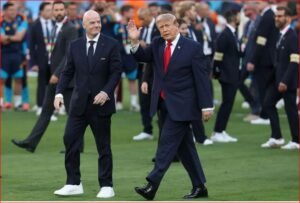
The final was one of the most influential gatherings of political leaders, royalty, sports personalities and entertainment personalities you have ever seen in a football game. Donald Trump was president of the main host country. He was joined in the presidential area by King Felipe VI and Queen Letizia, Spanish Prime Minister Pedro Sánchez and political representatives from the tournament’s three host countries. The Mexican president Claudia Sheinbaum and Canadian Prime Minister Mark Carney were also among the participants in the final ceremonies. Argentina President Javier Milei didn’t attend and was seen from his official residence in Buenos Aires.
FIFA President Gianni Infantino was also on the official delegation. Some of the celebrities who were seen and reported on at the final were:
Beyoncé and Jay-Z, Tom Cruise, Timothée Chalamet and Kylie Jenner, David and Victoria Beckham, Robbie Williams, Ronaldo Nazário, Shakira, Justin Bieber, Jennifer Hudson, Burna Boy and the rest of BTS.
Medals, individual awards and the trophy.
The Argentine players had to walk down to the presentation platform after the final whistle and receive their silver medals. The disappointment was evident in the eyes of Lionel Messi and others of the team, who had lifted the trophy in Qatar four years earlier. Then the champions’ gold medals were awarded to the Spanish team. President Trump, FIFA President Gianni Infantino, and other officials were at the podium. Some fans stormed the field when they walked out to applause. Spain Captain Rodri was eventually given the FIFA World Cup Trophy by Trump and Infantino. In the crowd in front of his teammates, he took it to the sky of New Jersey with the help of gold confetti, fireworks, and music.
The top individual awards were given to Spain as winners:
Adidas Golden Ball: Rodri of Spain, named the best player in the tournament;
Adidas Golden Boot: Kylian Mbappé of France, with ten goals; Adidas Golden Glove: Unai Simón of Spain;
Best Young Player: Pau Cubarsí of Spain.
The official FIFA awards report also revealed that Spain’s success was not just about one big goal but organization, control of the ball in the midfield, defensive stability and the confidence to trust the new generation
From North America 2026 to Brazil 2027.
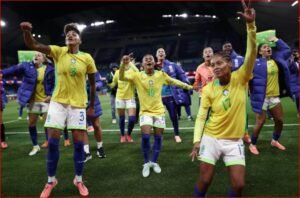
In the dark of New Jersey, world football turned its attention south to Brazil. The FIFA Women’s World Cup Brazil 2027 will be held from 24 June to 25 July 2027. It will be the tenth edition of the competition, and the first Women’s World Cup ever held in South America. FIFA. There will be 32 national teams playing in eight Brazilian host cities:
Belo Horizonte, Brasília, Fortaleza, Porto Alegre, Recife, Rio de Janeiro, Salvador e São Paulo.
The event is expected to take place at the Maracanã, Mineirão, Arena Corinthians, Arena Fonte Nova, Arena Pernambuco, Arena Castelão, Beira-Rio, and Estádio Nacional Mané Garrincha.
Spain will go into the 2023 women’s championship as the title holder, and Brazil will push home support for its first senior Women’s World Cup title.
A big chance for Africa and Brazil.
Brazil 2027 is no longer a football tournament for Africa. It is an opportunity for Africa and Brazil to develop sports, cultural and commercial relations. African women’s teams have never been so strong, and countries such as Nigeria, South Africa, Morocco and Zambia have shown that they are capable of rivaling global football nations. The history of Brazil and its cultural ties to Africa make the tournament a great place for Africa-Brazil tourism programs, supporter and cultural missions, women’s leadership forums, sports-business conferences, airline and hospitality partnerships, media cooperation, youth-football exchanges, sponsorship and investment opportunities, and promoting African and Afro-Brazilian culture. Afribraz Global Business Magazine and Afribraz Global Business Network feel Brazil 2027 is a chance to put African women, athletes, entrepreneurs, cultural leaders and institutions at the heart of a global conversation.
The Final Word.
The World Cup of 2026 began with 48 countries with divergent histories, aspirations and dreams. The game ended with a single captain winning the trophy, but the competition was more than just a champion’s. Spain deservedly earned a place at the top of world football. Argentina defended its crown with courage. Lionel Messi might have completed his World Cup journey. Lamine Yamal and a whole new generation arrived. Africa made incredible collective progress, and Cabo Verde proved that the size of a country does not determine the size of its dream. The final ceremony combined football, music, diplomacy and global celebrity. But in between all the fireworks and commercial spectacle, the main message was the same: that football still connects nations in ways that few other forces can. North America has now finished its story. The next global stage belongs to women’s football and Brazil. In June 2027, the world will meet again. And this time, South America will be able to bring the best women footballers to the tournament, and Brazil will be able to turn the tournament into a celebration of sport, inclusion, investment, and culture, as well as a better relationship between Africa, Brazil, and the world.
Afribraz Global Business Magazine will continue its special coverage with a new editorial series: “Road to Brazil 2027 African Women, Global Football and the Future of Sports Business.”

Leave feedback about this