


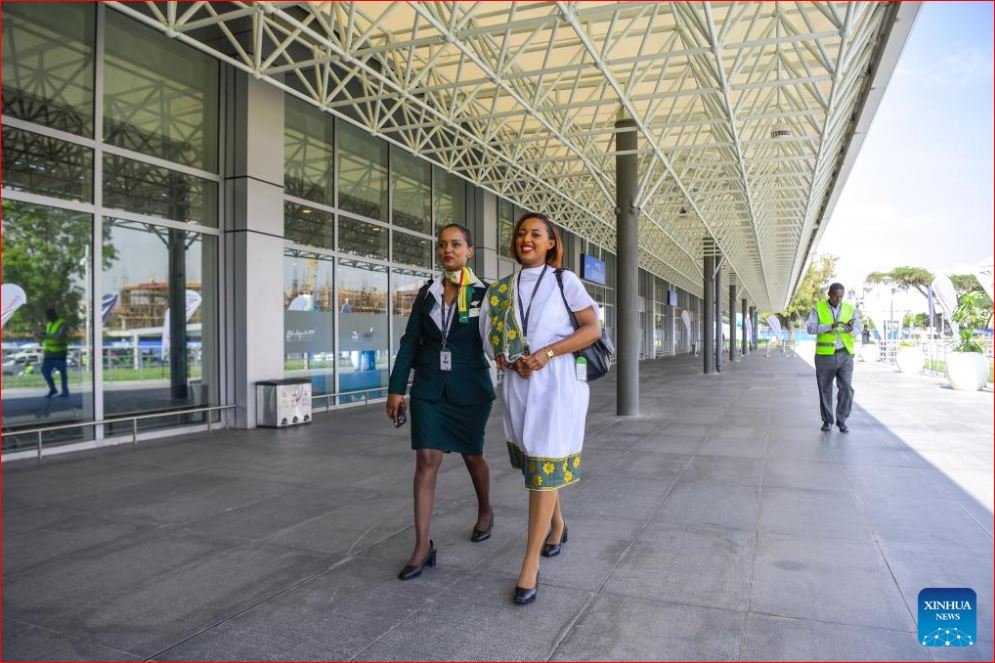
An Afribraz Global Business Magazine Exclusive
If aviation is the engine of globalization, then Ethiopian Airlines has quietly become one of the most influential engines driving the relationship between Africa and Brazil.
For decades, commercial relations between the two regions have been described as a market with enormous potential but insufficient connectivity. As diplomatic ties grow, business leaders have consistently identified transportation as one of the main barriers preventing trade, tourism, investment and academic exchange from reaching their full potential.
For each economic corridor to work out, there needs to be good connectivity.
Ethiopian Airlines, in this respect, has positioned itself as much more than an airline. It has become strategic infrastructure for Africa’s engagement with Latin America.
The Addis Ababa-São Paulo service is now more than just carrying passengers. It carries entrepreneurs attending investment forums, diplomats reinforcing bilateral ties, researchers getting into academic exchanges, tourists finding new destinations, humanitarian workers, sports delegations and members of the African diaspora reuniting with families and opportunities in other parts of the world.
Few airlines between Africa and South America can claim such a diverse and strategically important customer base.
Beyond Passengers: Connecting Economies

All of the international air routes create an invisible economic corridor.
When flights are reliable and frequent, companies are more likely to invest abroad. Trade missions are easier to plan. International conferences attract more people. Exporters have a more convenient way to access foreign markets. Investors can see projects in action instead of just getting reports.
In so many aspects, aviation precedes economic integration.
For African exporters looking to enter Brazil or Brazilian companies entering African markets, reliable air connections reduce uncertainty and costs.
This is especially important in light of the fact that African economies are still diversifying beyond traditional commodities into manufacturing, technology, agribusiness, pharmaceuticals, renewable energy, creative industries, and professional services.
Similarly, Brazilian expertise in agriculture, mining technology, aviation services, healthcare, engineering, biofuels, education, and infrastructure continues to attract interest in many African countries.
These conversations are made possible by reliable aviation.
Addis Ababa: Africa’s Connecting Hub
One of the top competitive advantages of Ethiopian Airlines is its geographical and operational nature of Addis Ababa.
Addis Ababa has evolved from being Ethiopia’s capital city to one of Africa’s most important aviation hubs, but also one of Africa’s most important.
Passengers leaving São Paulo will reach dozens of African destinations with a single connection, including major commercial centers such as Lagos, Nairobi, Johannesburg, Accra, Kigali, Dar es Salaam, Lusaka, Kinshasa, Maputo, Windhoek, Harare, and many others.
For Brazilian businesses that are not very familiar with Africa’s vast geography, this network greatly simplifies travel planning.
Instead of negotiating separate itineraries through multiple international carriers, Ethiopian Airlines has access to one of the continent’s most extensive route systems.
That connectivity reduces travel time while strengthening business confidence.
There are still tourism opportunities to be explored.
Tourism is still one of the sectors with the greatest untapped potential between Africa and Brazil.
But while both regions have natural beauty, cultural diversity, rich history and growing hospitality industries, with respect to other international markets, tourist flows are relatively limited.
A better air connection, better destination marketing, less visa processing, and more tourism promotion are also factors that can increase visitor numbers in both directions, industry professionals say.
Brazil offers African travelers world-famous beaches, ecotourism, cultural festivals, gastronomy, and business tourism.
African travelers can find unparalleled wildlife, ancient civilizations, UNESCO World Heritage Sites, luxury safaris, island destinations, adventure tourism, and a wealth of cultural experiences across 54 countries.
The bridge is already there.
The opportunity is there now to get more people to cross it.
Cargo: The Quiet Driver of Trade.

While passengers are always the focus of the public’s attention, cargo operations are another important dimension of Ethiopian Airlines’ contribution.
In fact, now international trade is increasingly dependent on efficient logistics.
Fresh agricultural products, pharmaceuticals, high-value manufactured goods, industrial equipment, perishables, flowers, medical supplies, and e-commerce shipments all require reliable air cargo networks.
Ethiopian Airlines has invested heavily in order to build one of Africa’s leading cargo operations (i.e. to become a logistics partner for companies across the continent).
As commercial relations between Africa and Brazil continue to mature, efficient cargo services will become all the more important.
In the case of exporters, speed is important.
Logistics is one of the key determinants of profitability for investors.
Looking to the Next Decade.
Experts now think that the relationship between Africa and Latin America is entering a new phase.
Population growth, urbanization, expanding middle classes, food security partnerships, energy cooperation, digital innovation, climate initiatives, educational exchanges and South–South cooperation are creating new opportunities that scarcely existed twenty years ago.
In fact, in the new world of aviation, we could not have been here without it.
Airlines are not only connecting airports.
They link ideas.
They connect investments.
They connect institutions.
And most of all they bring people together.
The airline is positioned to play a larger role in the next phase of relations between Africa and Brazil as it expands its presence in Latin America under leaders such as Mr. Biniyam Abdu.
Its airplanes carry far more than passengers.
They offer opportunities for more cooperation between two regions that in the last few years have come to understand one another as more than just distant partners, but as natural allies with shared history, opportunity and shared aspirations for sustainable development.





Leave feedback about this