


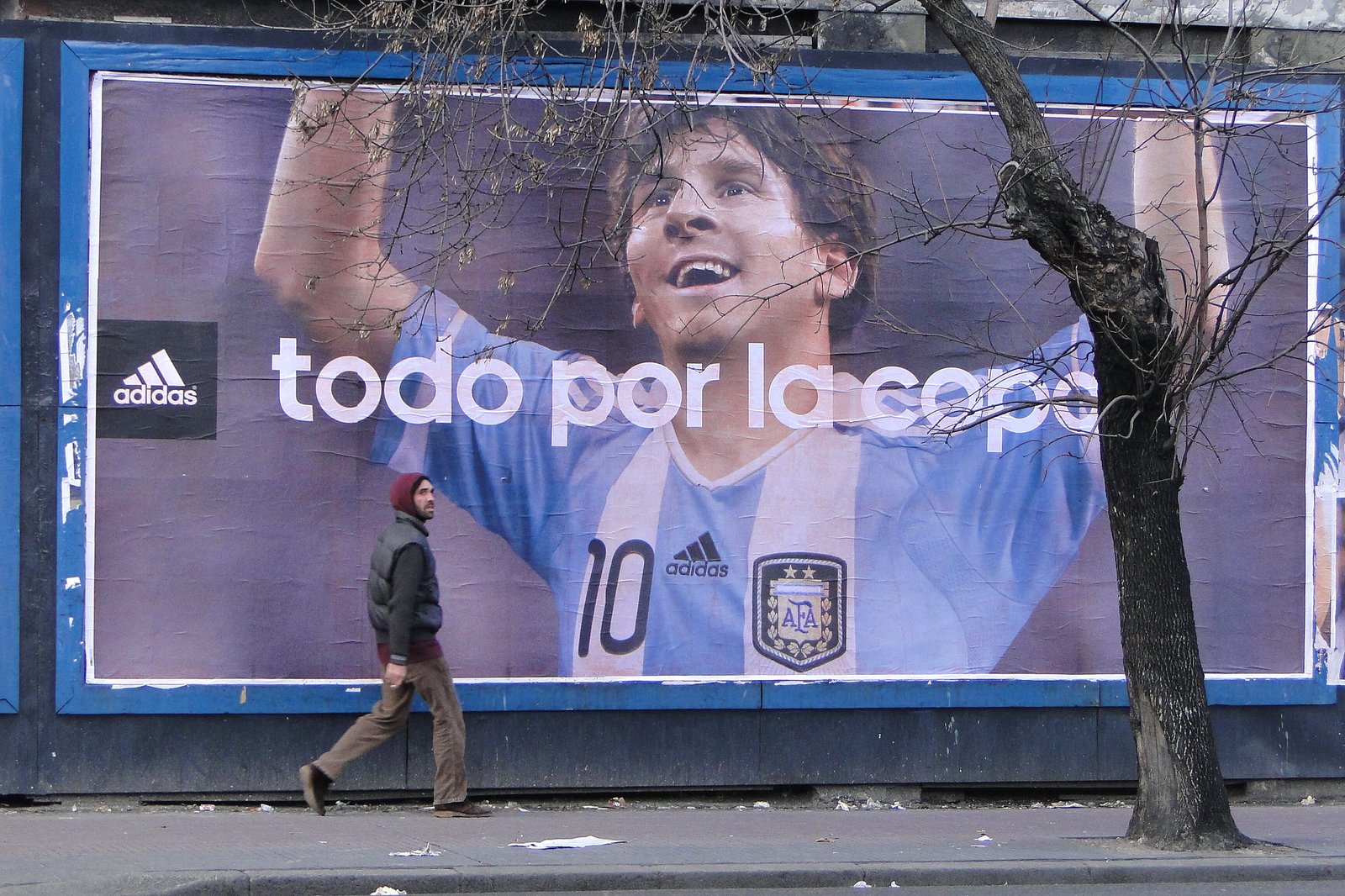
An emotional night at the Monumental marked the end of Lionel Messi’s international career, a journey from Rosario to world champion, defined by extraordinary talent, painful defeats, and a country’s enduring affection.
Sports | Football and Society
By I. E. Aroh — Afribraz Global Business Magazine
7 October 2026
Before the ball moved, Lionel Messi was already struggling to hold back his tears.
Standing beside his sons, Thiago, Mateo and Ciro, Argentina’s captain listened to the national anthem at a packed Estadio Monumental in Buenos Aires on Tuesday, October 6. He tried to sing, but emotion cut him off. Nearby, coach Lionel Scaloni was visibly moved. In the stands, supporters sang the words their number 10 could barely finish.
Argentina had come to say goodbye.
Messi’s farewell appearance ended in a 3–0 victory over Benin, with Nicolás Otamendi and Nicolás Paz scoring before the captain supplied the final goal. After more than two decades wearing the blue-and-white shirt, the country’s greatest modern football figure left his supporters with one last celebration.
The boy from Rosario
Born on 24 June 1987 in Rosario, Lionel Andrés Messi received his early football education at Newell’s Old Boys before moving to Barcelona at 13 in 2000. The move was about more than sporting ambition: Barcelona supported treatment for the growth-hormone condition that had complicated his childhood development.
His talent was unmistakable. The ball stayed close to his left foot; he changed direction before defenders could adjust. Even as a youngster, his game combined a scorer’s appetite with a playmaker’s awareness.
At Barcelona’s La Masia academy, those gifts developed within a football culture built around technique, movement, and an understanding of space. He made his first-team debut in a friendly against Porto in November 2003, aged 16, and made his competitive debut against Espanyol on 16 October 2004.
What followed transformed both the player and the club.
Messi scored 672 competitive goals for Barcelona and helped the team win 35 major trophies, including 10 Spanish league titles and four Champions Leagues. His progression from young winger to the side’s central creative force produced one of football’s most influential careers.
He could finish a move, construct it, or change its direction entirely. Defenders preparing for a dribble found a pass; those defending against it found him accelerating toward goal.
After leaving Barcelona in 2021, Messi played for Paris Saint-Germain before joining Inter Miami in 2023. His individual recognition included a record eighth Ballon d’Or in 2023. His international farewell closes one chapter while his club career continues.
Argentina’s love was earned through suffering
Messi’s relationship with Argentina was not always the uncomplicated devotion shown at the Monumental.
His senior international debut against Hungary in 2005 ended with an early red card. That difficult start would stand in stark contrast to the long career that followed.
Success came with the 2005 World Youth Championship and Olympic gold in Beijing in 2008. Yet senior international football brought repeated frustration. Argentina lost the 2014 World Cup final to Germany, then consecutive Copa América finals to Chile in 2015 and 2016. After the latter defeat, Messi briefly announced his international retirement before returning.
For years, his achievements at Barcelona sharpened expectations at home. Every disappointment reopened the question of whether he could deliver Argentina’s defining trophy.
That burden makes the eventual triumphs even more meaningful.
The breakthrough arrived in 2021, when Argentina defeated Brazil 1–0 at the Maracanã to win the Copa América. The Finalissima followed in 2022, then the World Cup in Qatar, and another Copa América title in 2024. Argentina also reached the 2026 World Cup final, losing 1–0 to Spain.
Under Scaloni, Messi found a team whose collective strength supported his brilliance. The captain, who had endured the defeats, finally experienced the fulfillment that had kept drawing him back.
 What Argentina witnessed on 6 October
The Monumental became the focal point of a farewell of national significance.
A giant number 10 shirt bearing a message of thanks lay on the pitch before the match. Messi’s children accompanied him during the ceremony, bringing the family dimension of his career to a setting usually dominated by competition.
Fabio Santana, a veteran of the Malvinas/Falklands War, performed the anthem. Supporters joined in at full voice as Messi and Scaloni struggled to contain their emotions.
In the tenth minute, the crowd paid collective tribute to the man identified with that shirt number. After the final whistle, a drone display extended the celebration above the stadium. When Messi recalled Argentina’s World Cup success in his speech, supporters chanted “champions.”
To say that “the whole country stood up for Messi” captures the symbolic scale of the occasion. The most striking scenes were at the Monumental: a full stadium, a communal anthem, sustained applause, and a captain reluctant to leave the field.
The Argentine Football Association’s tribute framed the farewell as a shared moment that extended into supporters’ homes, describing Messi as part of the nation’s collective memory. That was the federation’s emotional interpretation of the evening, and an indication of how deeply his career has entered Argentina’s public identity.
The affection carried the weight of everything that had preceded it. Supporters were thanking the champion, but also the player who had returned after disappointment and kept pursuing the same childhood ambition.
Pelé, Maradona and Suárez: other farewells that marked an era
Football has seen other departures when a stadium seemed to carry the feelings of an entire country.
Pelé’s final appearance for Brazil came against Yugoslavia at the Maracanã on 18 July 1971. The match ended 2–2, followed by a lap of honor and a ceremonial crowning. Like Messi’s farewell, it gave supporters a public opportunity to acknowledge a national sporting figure while he was still playing.
Diego Maradona’s tribute at La Bombonera on 10 November 2001 had a different character. It was a testimonial celebration, not his final competitive appearance for Argentina.
Surrounded by family and acclaimed by supporters, Maradona spoke about his mistakes and his enduring love for football. The occasion showed how an Argentine number 10 could become inseparable from his public’s emotions.
Luis Suárez’s international farewell on 6 September 2024 offers a more recent comparison. Uruguay drew 0–0 with Paraguay in a World Cup qualifier at the Centenario in Montevideo, where more than 60,000 supporters gathered to honor him. Former teammates and coach Óscar Washington Tabárez attended, linking his departure to the wider generation he had helped define.
These occasions differed in format and result. Their common force was recognition: supporters understood that a familiar presence, around whom years of expectation had accumulated, would no longer return in the same role.
The shirt will continue; the memory will endure
Argentina now faces the footballing challenge of continuing without Messi. No successor can replicate his precise blend of vision, balance, passing and finishing. The task will be to build on the next team’s strengths while preserving the collective conviction that helped his generation succeed.
For audiences in Brazil, Africa and around the world, his career also offers a lesson in development. Exceptional ability needs opportunity, patient coaching, and support to overcome obstacles. The young player who crossed the Atlantic required those foundations before he could become the figure celebrated in Buenos Aires.
On 6 October, Messi gave Argentina another goal. Argentina gave him its gratitude.
The number 10 shirt will be worn again. The years attached to his name will remain part of how a country remembers itself.
Sources of this article: afa.com.ar, fcbarcelona.com, reuters.com, fifa.com, Ge, acervos.ims.com.br





Leave feedback about this