


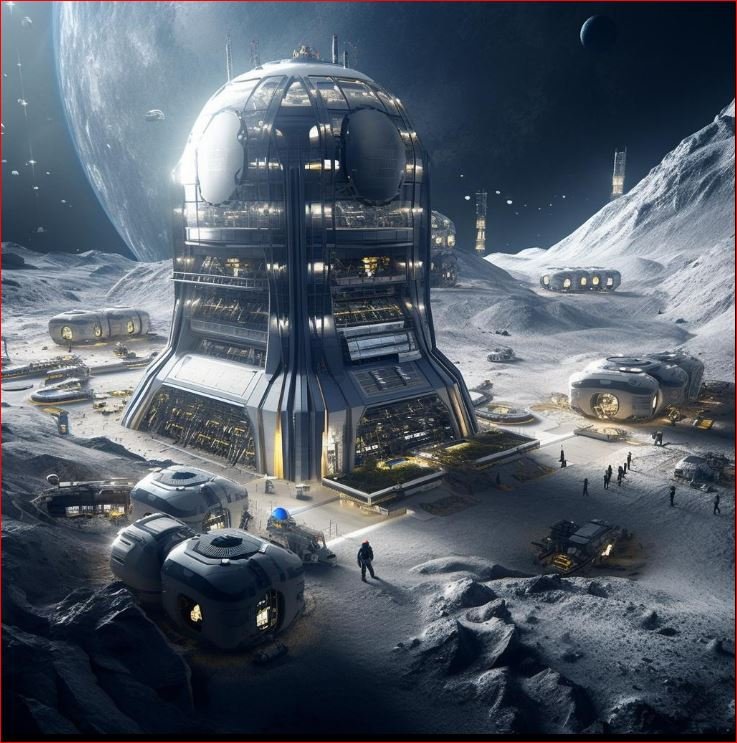
A New Lunar Era Begins
More than half a century after the Apollo 11 Moon Landing, humanity has re-entered lunar space with renewed ambition. The recent success of crewed missions under NASA’s Artemis Program, including the historic 2026 Artemis II flight, marks not just a return, but a transformation in purpose.
Artemis II carried astronauts farther than any humans have traveled in decades, validating systems that will soon support lunar landings and long-term habitation.
This moment signals a shift: from symbolic exploration to strategic expansion.

Beyond Flags: What the Future Holds
Unlike the Apollo missions, which were brief and politically driven, today’s lunar agenda is built around permanence, science, and economic potential.
1. Permanent Human Presence on the Moon
NASA’s roadmap includes multiple missions leading to sustained lunar activity, with planned landings and even early base construction before the end of this decade.
- Regular missions instead of one-time visits
- Lunar habitats (Artemis Base Camp concepts)
- Continuous human rotation on the surface
2. Water, Resources, and the Lunar Economy
One of the most critical discoveries reshaping lunar exploration is water on the Moon.
- Water ice exists in permanently shadowed craters near the south pole
- It can be converted into oxygen and hydrogen for breathing and fuel
- It determines where humans will land and build
However, recent findings suggest extraction may be difficult due to low concentrations, adding complexity to plans. This creates both opportunity and challenge, the foundation of a future space economy.
3. The Moon as a Gateway to Mars
The Moon is no longer the destination; it is the launch platform.
- Lower gravity makes it ideal for deep-space missions
- Technologies tested on the Moon will be used for Mars
- Artemis is explicitly designed as a stepping stone to interplanetary travel
This aligns with global ambitions to push human presence beyond Earth for the first time in history.
4. Global and Commercial Collaboration
Unlike the Cold War era, today’s missions involve a network of partnerships:
- Governments
- Private companies
- International agencies
This marks the beginning of a shared space economy, not a single-nation race.
The Deeper Question: What Are We Really Searching For?
Beyond engineering and economics lies a more profound dimension.
Humanity’s return to the Moon is not only about:
- Technology
- Resources
- Exploration
It is also about identity.
We are asking:
- Are we alone?
- Is life unique to Earth?
- What is our long-term future as a species?
This is the “subtlety” behind space exploration, the quiet but powerful search for meaning.





Leave feedback about this