


Afribraz Global Business Magazine
The road to the 2026 FIFA World Cup in the United States, Canada, and Mexico has delivered one of the biggest shocks in modern football history. Several traditional football giants, countries once feared across the globe, have failed once again to qualify for football’s biggest tournament.
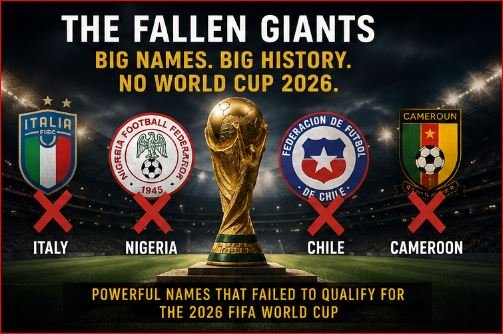
For decades, names like Italy, Nigeria, Chile, Cameroon, Poland, and China carried enormous football weight. Some were former champions, while others represented continental dominance in Africa, Europe, Asia, and the Americas. Today, however, world football has entered a new civilization, one driven not by population, history, emotion, or reputation, but by tactical intelligence, investment, youth systems, infrastructure, sports science, and long-term planning.
The football world is changing rapidly, and many of yesterday’s elephants are slowly disappearing from the global stage.
The Most Shocking Absentees of the 2026 FIFA World Cup
Italy — The Giant That Forgot Its Identity

Italy remains one of the greatest football nations ever produced. The country won the FIFA World Cup four times (1934, 1938, 1982, and 2006). Yet shockingly, Italy failed to qualify for the 2018, 2022, and now the 2026 FIFA World Cup consecutively.
This means an entire generation of young Italians has barely witnessed their country at football’s biggest stage.
Italy once terrified opponents with defensive discipline, tactical mastery, and world-class stars. Today, critics point to:
- weak youth development,
- financial instability in clubs,
- overdependence on foreign players in Serie A,
- and inconsistent tactical rebuilding.
The elimination by Bosnia and Herzegovina in the playoffs became symbolic: football history alone no longer wins matches.
Nigeria — Africa’s Sleeping Super Eagle

Nigeria remains one of Africa’s most talented football nations. Between 1994 and 2018, the Super Eagles qualified for six out of seven World Cups, producing legends like Jay-Jay Okocha, Nwankwo Kanu, Rashidi Yekini, and John Obi Mikel.
Yet Nigeria failed to qualify for both the 2022 and 2026 FIFA World Cups.
This decline has shocked many football observers because Nigeria possesses:
- over 220 million people,
- massive football passion,
- huge diaspora talent pools,
- and one of Africa’s strongest football histories.
However, modern football now demands:
- stable football administration,
- proper grassroots development,
- tactical continuity,
- sports science,
- and long-term investment.
Raw talent alone is no longer enough.
Countries with smaller populations but stronger football structures are now outperforming traditional giants.
Chile — The Golden Generation That Faded
Chile shocked the world when they won back-to-back Copa América titles in 2015 and 2016, defeating football giants like Argentina.
With stars such as Alexis Sánchez and Arturo Vidal, Chile became one of South America’s most feared teams.
But today, Chile has failed to qualify for three consecutive World Cups:
- 2018,
- 2022,
- and 2026.
The major problem has been the inability to renew their squad after the golden generation aged. Modern football punishes nations that fail to rebuild quickly.
Cameroon — From Indomitable Lions to Uncertain Future
Cameroon once symbolized African football greatness. They reached the World Cup quarterfinals in 1990, the first African nation ever to do so.
With legends like Roger Milla, Samuel Eto’o, and Rigobert Song, Cameroon inspired generations across Africa.
Yet Cameroon failed to qualify for the 2026 FIFA World Cup.
Internal administrative conflicts, inconsistent development systems, and instability have weakened a nation once feared by the football world.
China — Billion-Dollar Investment Without Global Results
China invested billions into football development:
- importing famous coaches,
- signing global stars into the Chinese Super League,
- and building football academies.
Yet China again failed to qualify for the FIFA World Cup, continuing a painful wait since their only appearance in 2002.
This proves one important reality:
Money alone cannot build football success overnight.
Football culture, youth development, coaching philosophy, patience, and technical systems matter more than expensive headlines.
Poland and Denmark — European Powers Left Behind
Poland, led by world-class striker Robert Lewandowski, also failed to qualify for the 2026 tournament. Denmark, one of Europe’s strongest recent teams and semifinalists at Euro 2020, surprisingly missed out as well.
This shows how brutal modern qualifications have become.

Football Has Changed Forever
The 2026 FIFA World Cup is the first-ever expanded 48-team tournament. Yet even with more qualification slots available, several giants still failed to make it.
This demonstrates how competitive football has become globally.
Today:
- smaller nations are investing smarter,
- tactical football has improved everywhere,
- sports analytics dominate modern coaching,
- youth academies are becoming more advanced,
- and football knowledge is now globalized.
The era when “big names” automatically qualified is over.
The Rise of the New Football Nations
While some giants disappeared, new football nations emerged proudly:
- Uzbekistan qualified for the first time,
- Jordan reached a historic qualification,
- Cape Verde continued its rise,
- and DR Congo returned to the global stage after decades away.
These countries succeeded not because of population size, but because of:
- organization,
- planning,
- tactical evolution,
- discipline,
- and strategic investment.
The New Civilization of Football
Football is no longer controlled by only Europe’s old powers or historically dominant nations.
Today, football has entered every corner of the world:
from African villages,
to Asian academies,
to Caribbean islands,
to Middle Eastern football projects.
Technology, video analysis, artificial intelligence, sports medicine, nutrition, and scouting networks have transformed the game completely.
The modern game belongs to nations that:
- prepare better,
- invest wisely,
- manage professionally,
- and think long-term.
Final Reflection
The failure of traditional football giants to qualify for the 2026 FIFA World Cup is not simply a sporting disappointment; it is a global warning.
In modern football:
- Reputation does not score goals,
- History does not defend attacks. The
- population does not win tournaments,
- and famous names no longer frighten opponents.
Only preparation, structure, tactics, discipline, and vision can survive modern football.
The giants who fail to adapt risk becoming forgotten memories in football history, while new nations rise boldly into the future.





Leave feedback about this