


By Afribraz Global Business Magazine Editorial Team
In the modern political and economic history of Nigeria’s South-East, few developments have generated as much strategic conversation in recent times as the proposed deep seaport initiative championed by the Governor of Abia State, Alex Otti.
To many observers, this is not merely another infrastructure announcement. It is increasingly viewed as part of a broader economic awakening in the South-East, one that seeks to reconnect the Igbo economy to global trade, industrial expansion, diaspora investment, and Atlantic commercial opportunities.
Since assuming office, Governor Otti’s administration has attracted national attention through aggressive infrastructural reforms, road rehabilitation projects, urban renewal initiatives, healthcare improvements, educational restructuring, and efforts aimed at reviving commercial confidence in Abia State.
Across major cities like Aba and Umuahia, residents and business operators increasingly speak of renewed government presence, improved public infrastructure, and a more investment-oriented administrative style.
For many Ndi Igbo at home and abroad, Alex Otti represents a growing symbol of strategic governance and economic pragmatism. His corporate and financial background continues to shape public perception that he understands not only politics, but also the mechanics of commerce, logistics, infrastructure financing, and long-term regional competitiveness.
The Seaport Initiative: A Strategic Dream for the South-East
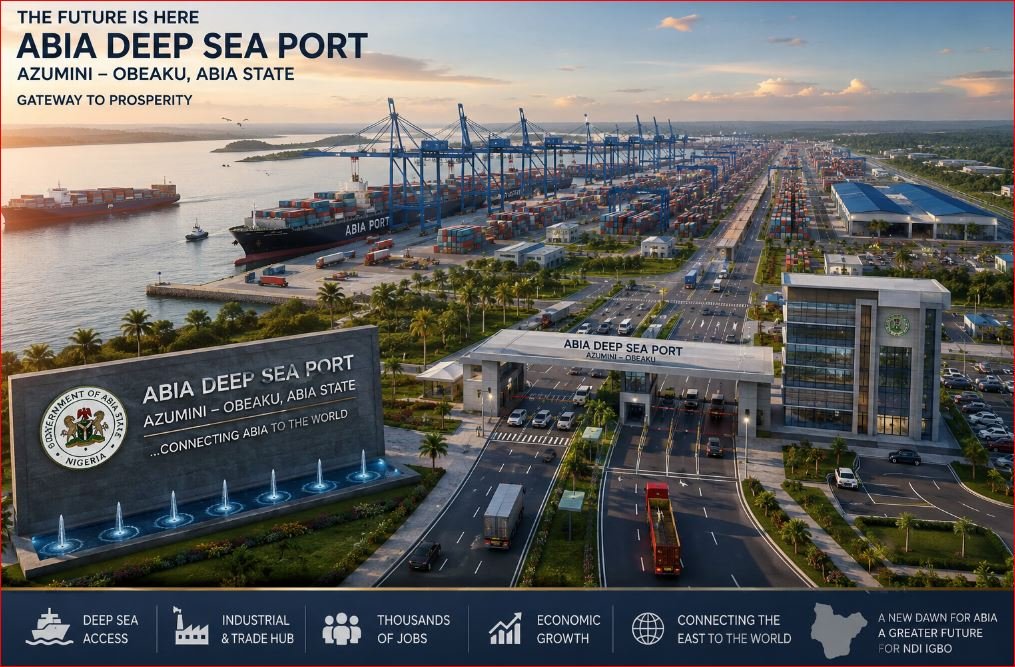
One of the most ambitious conversations now emerging from Abia State is the proposed Azumini–Obeaku Deep Seaport project.
The initiative, currently advancing through feasibility and technical assessment stages, has sparked excitement across business circles, diaspora communities, and industrial stakeholders. The governor’s decision to push for technical studies before full implementation has also been interpreted as a sign of caution, seriousness, and strategic planning rather than political symbolism.
For decades, the South-East has remained one of Nigeria’s strongest commercial regions without possessing a major functional seaport directly serving its industrial and trading ecosystem.
This imbalance has forced traders, manufacturers, and importers from the South-East to rely heavily on distant maritime gateways, particularly Lagos and Port Harcourt, often facing enormous transportation costs, cargo delays, congestion, and logistics bottlenecks.
The proposed Abia deep seaport could potentially alter that reality.
What the South-East Could Gain
Economically, the implications could be transformational.
A viable seaport connected to industrial and commercial corridors could reduce shipping and transportation costs for businesses operating in Aba, Onitsha, Nnewi, and neighboring commercial centers.
The project could stimulate:
- Export-oriented manufacturing,
- Agro-processing industries,
- Warehousing and logistics,
- Inland dry ports,
- Shipping and maritime services,
- Industrial clusters,
- Job creation,
- Foreign direct investment.
More importantly, it could reposition the South-East as one of Africa’s emerging industrial and export hubs under the framework of the African Continental Free Trade Area (AfCFTA).
For many analysts, the strategic value of the project goes beyond maritime transportation. It is fundamentally about economic decentralization and regional competitiveness.
Aba: The Industrial Heart Waiting for Reconnection
Historically, Aba has remained one of West Africa’s most recognized indigenous industrial cities.
From leather production to garment manufacturing, metal fabrication, footwear, spare parts, and entrepreneurial innovation, Aba has long embodied the commercial resilience and productive spirit of Ndi Igbo.
Yet despite its industrial energy, infrastructure limitations and logistics challenges have constrained its global potential for decades.
A deep seaport linked through modern rail and road infrastructure could dramatically improve export access for Aba-made products into African, European, Caribbean, and Latin American markets.
For many business observers, the vision represents the possible rebirth of Aba as a major manufacturing gateway for West Africa.
Alex Otti’s Symbolism Among Ndi Igbo
Within Igbo political and economic conversations, Alex Otti’s growing reputation increasingly transcends ordinary governance discussions.
To many supporters, he symbolizes:
- Strategic leadership,
- Economic modernization,
- Industrial revival,
- Infrastructure-driven development,
- Diaspora reconnection,
- Long-term regional planning.
Among Igbo diaspora communities in Brazil, the United States, Canada, the United Kingdom, and across the Caribbean, conversations surrounding investment back home are becoming increasingly linked to infrastructure confidence and governance credibility.
For many diaspora investors, logistics infrastructure is one of the most critical foundations for long-term industrial investment.
Brazil, the Caribbean, and the Atlantic Connection
The Atlantic Ocean has historically connected West Africa to Brazil and the Caribbean for centuries through migration, culture, commerce, and human movement.
Today, that same Atlantic corridor is regaining importance economically.
As Africa seeks deeper trade integration with Latin America and the Caribbean, maritime infrastructure becomes increasingly strategic.
A future South-East maritime gateway could potentially strengthen:
- Nigeria–Brazil trade,
- Agricultural exports,
- Diaspora investment flows,
- Maritime logistics partnerships,
- Manufacturing exports,
- Tourism and cultural exchanges,
- Afro-Atlantic business cooperation.
Brazil, in particular, stands as one of the most important economies in the Global South, with growing African engagement in agriculture, aviation, energy, infrastructure, and industrial trade.
For Igbo entrepreneurs and African diaspora business communities in Brazil and the Caribbean, the possibility of stronger direct economic connectivity with the South-East carries enormous symbolic and commercial significance.
Can the Dream Become Reality?
Building a deep seaport is not a simple political project.
It requires:
- Massive financing,
- Environmental studies,
- Federal approvals,
- Dredging operations,
- Rail integration,
- Security stability,
- Private sector participation,
- Long-term political continuity.
Technical feasibility will ultimately determine the practical path forward.
Yet many economists argue that the importance of the initiative already lies in the fact that the South-East is beginning to think strategically again about large-scale industrial infrastructure, maritime competitiveness, and global economic positioning.
Even the movement toward feasibility studies signals a shift in regional ambition.
Positioning the South-East Globally
If successfully implemented alongside industrial parks, transportation corridors, inland logistics systems, and export-processing zones, the Abia seaport vision could significantly reposition the South-East within Africa’s evolving economic order.
The region could emerge as:
- A manufacturing powerhouse,
- A logistics gateway,
- A diaspora investment destination,
- An export-processing hub,
- A strategic Atlantic trade corridor.
More importantly, it could redefine how Ndi Igbo participate in global commerce in the twenty-first century.
For many observers, that is the deeper meaning behind Governor Alex Otti’s seaport initiative.
It is not simply about ships, cargo, or ports.
It is about economic identity, regional ambition, industrial rebirth, and reconnecting the South-East to the wider world.






Leave feedback about this