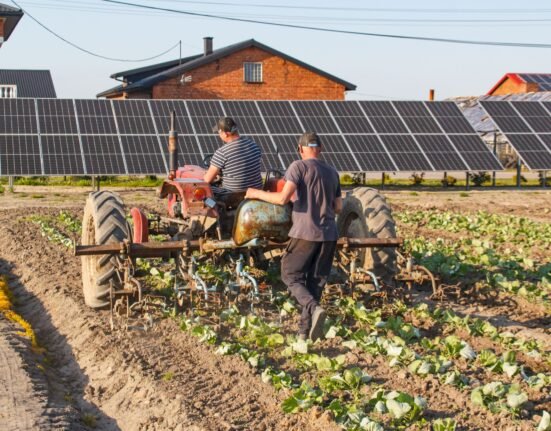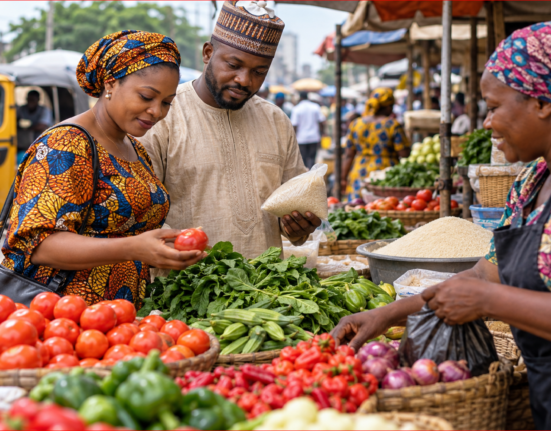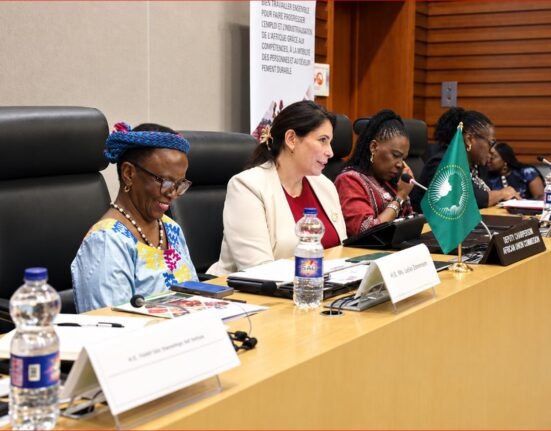


Artificial intelligence, agricultural technology, and clean energy are opening new development pathways. Their lasting value will depend on local expertise, reliable infrastructure, and partnerships that deliver measurable results.
Technology | Business & Brazil – Africa Cooperation
Original text by George Bassey | Editorial adaptation by Editorial Desk – Afribraz Global Business Magazine
In Mali, a Brazil-Africa agricultural cooperation project helped establish cotton research facilities, including a laboratory to breed natural enemies of crop pests and a cold chamber to preserve genetic resources. It also supported soil rehabilitation and biotechnology laboratories, along with training and adapting Brazilian farming techniques.
This is a concrete example of how innovation travels: through equipment, knowledge, and people learning to apply technology under local conditions.
Today, a broader transformation is unfolding across artificial intelligence, biotechnology, energy storage, robotics, and satellite systems. These advances could change how countries grow food, power businesses, and develop industries. But scientific achievement alone does not guarantee economic progress.
For Brazil and African economies, the central challenge is turning technological possibilities into productive capacity and ensuring that the benefits reach beyond a small circle of investors and specialists.
Innovation is spreading, but opportunity remains unequal
The World Intellectual Property Organization’s Global Innovation Index 2026, released on 29 September 2026, ranks 139 economies using 79 indicators. Switzerland, Sweden, the United States, the Republic of Korea, and Singapore rank highest. WIPO also identifies upward trajectories in economies including Brazil, Morocco, and Mauritius.
These findings suggest that innovation capability is expanding beyond its traditional centers. They do not mean that differences in research capacity, infrastructure, and access to finance have disappeared.
Investment remains highly concentrated. WIPO’s 2026 innovation tracker reports that artificial intelligence companies attract more than half of global venture-capital investment, while overall innovation continues to progress more slowly than before.
For emerging economies, competing in this environment requires deliberate choices. Which technologies address pressing local needs? Which can support viable businesses? And where will investment build skills and institutions that endure?
Agriculture, digital services, and reliable energy offer practical starting points for examining those questions.
Agriculture: cooperation already has a foundation

Brazil – Africa agricultural collaboration provides a documented example of technology transfer.
The original Cotton-4 project, implemented from 2009 to 2013, involved Benin, Burkina Faso, Chad, and Mali. A Brazilian government initiative through the Brazilian Cooperation Agency, it transferred cotton production technologies intended to improve yields and fiber quality.
Embrapa’s account of the subsequent Cotton-4 + Togo initiative describes training, institutional strengthening, and adapting technologies ranging from seeds to no-till farming and integrated pest management.
The distinction matters: these sources document activities and facilities but do not establish a uniform productivity increase across every participating country.
The broader lesson is nevertheless useful. Agricultural technology needs local testing, extension services, and institutions that can support farmers after a project ends. Soil conditions, rainfall, pests, financing, and market access differ between countries – and within them.
Future cooperation could explore crop research, food processing, storage, and agricultural information services. These are potential areas for partnership, rather than announcements of new agreements.
Their commercial value would depend on evidence from the intended market: reduced losses, improved product quality, lower operating costs, or more reliable access to buyers.
Artificial intelligence: useful advice must fit local realities
AI’s business potential extends beyond generating text and images. One important application is helping people navigate specialized information.
CGIAR has described its development of AgriLLM, an agricultural advisory initiative designed to ground AI responses in scientific knowledge and local realities. Preparatory workshops in Nairobi in June 2025 brought researchers together to develop question-and-answer materials for users, including farmers and extension agents. This represents development work, not proof of widespread deployment or demonstrated income gains.
A separate initiative in Kenya illustrates why design and access matter. Under the AICCRA project, researchers working with the iShamba advisory platform analyzed more than 9,000 farmer queries submitted between 2020 and 2025. The project identified issues, including English-dominant responses and differences in how it handled women’s questions. Its planned next steps include expanded multilingual support.
The implication reaches beyond farming. An AI service can appear efficient while serving some users poorly.
For companies operating between Brazil and African markets, translation, customer support, and document analysis could reduce administrative burdens. But businesses must assess accuracy, confidentiality, language coverage, and human oversight before relying on these tools.
An agricultural recommendation must fit the crop and location. A commercial translation must preserve meaning. A business decision needs verifiable information.
Successful adoption begins with a specific task and a way to measure whether the tool improves it.
Nigeria’s energy program highlights the scale of the challenge

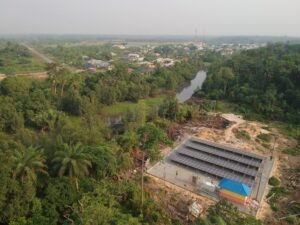
Reliable electricity underpins technological development. A business cannot fully benefit from digital tools, refrigeration, or automated equipment if its power supply repeatedly fails.
Nigeria’s Distributed Access through Renewable Energy Scale-up project, known as DARES, shows how infrastructure and financing are addressing energy access.
The World Bank approved the project on December 14, 2023, with support from a US$750 million International Development Association credit. Its stated objective is to provide more than 17.5 million Nigerians with new or improved electricity access through distributed renewable energy solutions. These figures reflect financing and intended reach; they should not be presented as completed results.
Nigeria’s Rural Electrification Agency describes DARES as a program that supports private-sector-led renewable generation for households and micro, small, and medium-sized enterprises.
For prospective technology partners, this underscores electricity’s importance for productive uses. Power becomes economically valuable when it enables a workshop to operate equipment, a retailer to preserve goods, or a processor to increase output.
However, a large program does not guarantee contracts or returns for individual suppliers. Companies must establish eligibility, understand procurement and financing arrangements, and demonstrate that their systems can operate reliably.
Potential Brazilian participation would require suitable products, qualified local partners, maintenance arrangements, and compliance with applicable requirements.
Separate available solutions from emerging technologies
The energy innovation landscape is active, but technologies are advancing at different speeds.
The International Energy Agency’s The State of Energy Innovation 2026, published on 17 February 2026, identifies more than 150 significant innovation developments in 2025 and reports that over 320 energy start-ups received their first funding that year.
Its analysis covers sodium-ion batteries, perovskite solar cells, next-generation geothermal systems, and fusion research. These should not be treated as equally ready for commercial deployment.
The same report also documents financing and execution challenges, including project delays and cancellations. Energy technology venture-capital investment declined for a third consecutive year in 2025, to US$27 billion.
Investors therefore need to distinguish among established equipment, technologies under demonstration, and research with an uncertain commercial timetable.
The right choice depends on operating conditions and the total cost over the system’s life, not simply the technology’s novelty.
Read Similar Article …
- Women Must Shape Peace, Not Merely Witness It: African Union Pushes for Action in Eastern DRC
- The Food Crisis On Our Menu
- From Fufu to Jollof: São Paulo’s Growing African Food Scene
Biotechnology, robotics, and space expand possibilities
Other advances deserve attention, though their relevance will vary by sector.
In medicine, the FDA’s December 8, 2023, approval of Casgevy marked the first FDA-approved treatment using CRISPR/Cas9 genome-editing technology. Its initial approval covered eligible patients aged 12 and older with sickle cell disease and recurrent vaso-occlusive crises. It was a significant therapeutic milestone, with a defined indication rather than a universal solution to inherited disease.
Access still requires specialist care, financing, and appropriate clinical infrastructure.
Robotics likewise needs assessment against a specific task: whether a machine can improve safety, quality, or productivity in the intended working environment.
Space technology offers an established example of practical infrastructure. Brazil’s INPE describes CBERS-4A, launched on December 20, 2019, as an environmental monitoring instrument equipped with three imaging cameras.
Satellite observations can support decisions, but institutions and businesses need people who can interpret the information and act on it.
Across these fields, equipment and expertise must develop together.
Partnerships must build lasting capacity
For Brazil–Africa cooperation, the strongest projects will begin with a demonstrated need and a credible path to implementation.
Partners should clarify who finances deployment, who trains workers, who maintains equipment, and how they will measure performance. Agreements should also define clear responsibilities for data, intellectual property, and commercial risk.
A pilot should answer practical questions: Does the technology work locally? Will customers use it? Can the service remain affordable? Is there a viable operating model after initial support ends?
The consequences for workers and communities also deserve attention. Automation can change employment requirements. Digital services can exclude people without connectivity or suitable language support. Energy and industrial projects need assessment for their environmental effects.
These considerations influence whether a project succeeds and whether its benefits are broadly shared.
The innovation revolution is already underway. For Brazil and Africa, its value will be measured by farms that become more productive, businesses that gain dependable power, and people who acquire useful skills.
The partnerships worth pursuing are those that can demonstrate these outcomes and leave local organizations better equipped to build what comes next.
By Official White House photo by David Lienemann – https://obamawhitehouse.archives.gov/photos-and-video/photo/2011/08/dr-jill-biden-tour-kenya-agriculture-research-institute-nairobi-kenyaAgricultural research facility in Kenya, Public Domain, https://commons.wikimedia.org/w/index.php?curid=21460158
Sources on this article : Portal Embrapa, www.wipo.int, CGIAR System , worldbank.org , Dares, www.iea.org, www.fda.gov, Dados Geoespaciais