
Sports Governance & Development
Two consecutive World Cups missed by the Super Eagles, a historic qualification failure by the Super Falcons, and years of neglect across the domestic game have brought Nigerian sport to a defining moment. Changing officials will not be enough. The structure itself must change.
By IEAroh — Afribraz Global Business Magazine
ABUJA, NIGERIA — 1 September 2026
Nigeria’s sporting crisis is not a crisis of talent. It is a crisis of leadership, planning and accountability.
More and more gifted footballers and athletes are emerging from schools, neighborhood fields, local clubs and private academies across the country. Some eventually reach the international stage. Many others disappear, not because they lack ability but because Nigeria has no reliable system for identifying, developing and protecting them.
Recent results have brought that failure into sharper focus. The Super Eagles missed the FIFA World Cup for the second consecutive time in 2026 after failing to qualify for the tournament. The Super Falcons also failed to reach the 2027 FIFA Women’s World Cup, meaning Nigeria has been at every edition since the competition started in 1991.
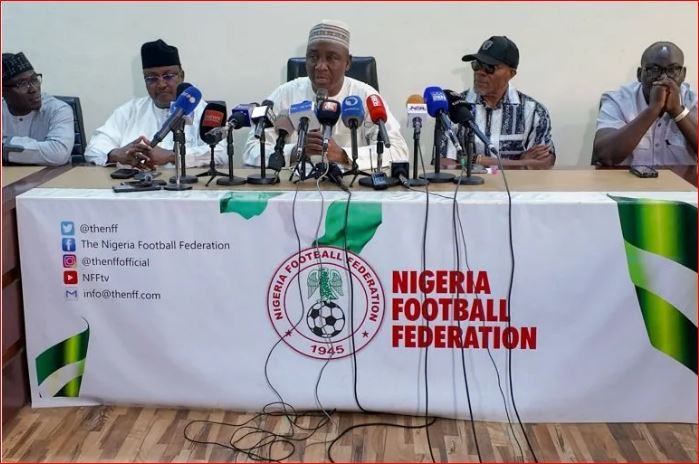
The consequences reached the highest level of Nigerian football administration. On August 27, 2026, Nigeria Football Federation president Ibrahim Musa Gusau, general secretary Dr Mohammed Sanusi, and members of the NFF Executive Committee resigned amid mounting public anger over the national team’s performance.
Dr. Emmanuel Ikpeme, who was the NFF deputy general secretary at the time, was then appointed to oversee the secretariat on an interim basis.
The resignations were significant, but they should not be taken as reform.
Nigeria has removed coaches, replaced ministers, dissolved committees, and changed federation officials before. The faces change, but the weaknesses remain: poor preparation, questionable decision-making, inadequate grassroots development, unstable coaching arrangements, neglected facilities and a lack of financial transparency.
The main question is no longer whether Nigerian sport is in trouble. This is why the same problems have survived every leadership change.
Super Eagles: Big Names, Small Returns

On paper, Nigeria should be one of Africa’s strongest football nations, with players like Victor Osimhen, Ademola Lookman, Alex Iwobi, Samuel Chukwueze, Calvin Bassey and Moses Simon, playing in top international leagues. The squad has experience, physical quality and individual ability. Yet the Super Eagles have struggled to translate that talent into consistent national-team performances.
Nigeria’s run to the 2023 Africa Cup of Nations final in Côte d’Ivoire in early 2024 showed what organization and discipline could accomplish. Although the Super Eagles lost the final to the host nation, they returned home as continental runners-up. The performance should have laid the foundation for a stable football project; instead, the period that followed was marked by coaching uncertainty, administrative friction, delayed appointments, and inconsistent preparation.
Nigeria ultimately recovered with the 2026 World Cup campaign, but the damage done earlier was severe; the campaign ended against the Democratic Republic of Congo after a 1-1 draw and a 4-3 penalty shootout defeat. For the first time since the 1986 and 1990 qualification cycles, Nigeria is absent from two consecutive men’s World Cups.
The players cannot escape responsibility. Important chances were missed, concentration dropped at decisive moments, and some performances lacked the urgency expected of footballers representing a three-time African champion.
But the failure was bigger than any player or one match; players do not appoint national-team coaches, organize training camps, maintain stadiums, pay bonuses, or design long-term technical programs. When these areas are poorly managed, even talented teams become unstable.
The NPFL and Nigeria’s Disappearing Local Talent
The continued marginalization of players in the Nigeria Premier Football League remains one of the clearest signs of a disconnected football system. NPFL players face conditions that would test any professional; some clubs struggle with delayed salaries, poor pitches, inadequate medical support, exhausting road travel, and weak contract enforcement.
Players are expected to deliver results while shouldering risks that shouldn’t exist in a properly regulated professional league. Even when they perform well, recognition is not forthcoming.
A player can be good for months in the NPFL without serious national team consideration. If the same player signs for an overseas club, even one below the standard of Nigeria’s best teams, his chances of being noticed can suddenly change. That sends a damaging message that success in the Nigerian league is not enough. It also encourages talented footballers to leave prematurely. Some accept poorly structured contracts in foreign countries simply to claim the label of “foreign-based player.” Others remain trapped in exploitative contracts and disappear entirely from the national football conversation.
Nigeria’s poor performance at the delayed 2024 African Nations Championship, staged in 2025 and reserved for footballers playing in their domestic leagues, exposed the depth of the problem. Low and irregular salaries, limited tactical development, inadequate coaching, and the constant departure of promising players have weakened Nigerian clubs.
Premium Times: The NFF needs a permanent scouting department dedicated to the domestic game. NPFL performances should be documented with reliable technical and physical data. The best local players should attend regular development camps and be assessed alongside foreign-based professionals. If a local player is not good enough, technical evidence should show it. He should not be dismissed simply because he plays at home.
Super Falcons: A Historic Warning

The Super Falcons’ failure to qualify for the 2027 Women’s World Cup in Brazil is as much a disappointment as it is a concern. What happens when historic success has been taken for granted?
Nigeria dominated African women’s football for decades and qualified for every Women’s World Cup. And so, that record sometimes made it seem as though success would continue automatically. It did not.
Other African countries have invested heavily in women’s leagues, coaching, sports science and youth development. Morocco, South Africa and Zambia have made significant progress. Competition across the continent has intensified, and Nigeria’s domestic women’s football structure has struggled to keep pace.
The Super Falcons still have experienced and talented players, but reputation no longer wins qualification matches.
Nigeria must now rebuild its women’s football program from the grassroots. That requires properly financed leagues, better youth competitions, qualified coaches, medical support and more competitive matches at every level of the game.
The country cannot respond to this failure by only focusing on the senior team. By the time the players reach the Super Falcons, the development work should already have been done.
Related issues:
- From Ricky To A New Era: African Footballers In Brazil
- Migrants and Refugees World Cup 2026: When Football Becomes a Bridge For Integration, Dignity, and Citizenship
- From Mexico City to Spain’s Triumph: The World Cup That Redefined Global Football.

The Crisis Beyond Football
Nigeria’s problems are not limited to the NFF. At the Paris 2024 Olympic Games, the country sent 88 athletes to compete in 12 sports but returned without a medal. And for a nation as big as Nigeria, with its history of sports success and history of producing world-class athletes, it was quite a disappointment.
There were great achievements. D’Tigress became the first African basketball team (male or female) to reach the Olympic quarter-finals. Some Nigerian athletes also fought bravely against the world’s best.
Nevertheless, individual courage could not hide institutional weakness. Nigerian athletes have been frustrated for decades by delayed funding, rushed preparation, poor international competition, outdated equipment, and simple administrative failures. In some cases, preparations that should cover an entire Olympic cycle are compressed into the months before the Games.
The handling of sprinter Favour Ofili became one of the clearest examples. Ofili missed the women’s 100 meters at the Paris Olympics after her name was not entered for the event, despite having qualified. She had already missed the Tokyo Games because Nigeria failed to meet the required out-of-competition anti-doping testing conditions. Two Olympic cycles were affected by administrative failures beyond the athlete’s control.
Ofili had earlier attempted to switch her sporting nationality to Türkiye after years of frustration with Nigeria’s athletics administration. World Athletics rejected the transfer in April 2026 as part of a wider decision on 11 athletes recruited by Türkiye. Reuters
That did not erase her reasons for wanting to leave.
When a world-class athlete loses faith in her career management, the very first thing that should happen is not to question her loyalty. It should be to examine how the system failed her.
The Officials Leading Nigerian Sport
Nigeria’s national sports policy is overseen by the National Sports Commission, which President Bola Ahmed Tinubu restored in October 2024.
Mallam Shehu Dikko is Chairman, and Hon. Bukola Olopade serves as the Commission’s director-general.
Both men bring experience in sports administration. Their challenge is to demonstrate that their experience can deliver measurable reform rather than another cycle of ambitious announcements.
Mallam Shehu Dikko — NSC Chairman
Shehu Dikko studied Quantity Surveying at Ahmadu Bello University and later earned a postgraduate diploma in management and an MBA.
His career has included serving as a FIFA Goal Project manager in Nigeria, as an adviser to the House of Representatives Committee on Sports, and as chairman of the former League Management Company, which administered the Nigerian professional league.
Dikko therefore knows Nigerian football from the inside. That familiarity can be an advantage, but it also invites legitimate scrutiny.
Several problems now under review, including the state of the professional league, emerged or persisted during the years he held influential positions. Nigerians can therefore ask what will be different under his leadership of the NSC.
Experience should not be measured by the number of offices held. It should be judged by clear, independently verifiable outcomes.
Hon. Bukola Olopade – NSC Director-General
Bukola Olopade was appointed director-general of the NSC in November 2024.
He has previously served as Ogun State Commissioner for Youth and Sports and chaired the Local Organizing Committee of the National Sports Festival. He has also been involved in road races, football projects and other privately organized sporting events.
His commercial and event-management experience could help Nigeria attract private investment and reduce the sector’s dependence on government funding.
But the building of a sustainable national sports system is different from hosting successful events. The real tests will be athlete welfare, functioning facilities, federation accountability, private investment, grassroots participation and improved international results.
The commission has promoted an “athletes first” policy and elite-development programs. President Tinubu also directed that sports funding should become more predictable beginning with the 2026 budget year. Premium Times
The NFF leadership that failed to deliver.
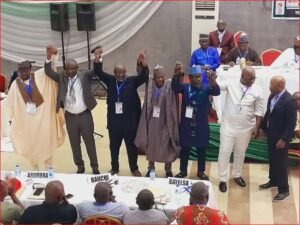

Ibrahim Musa Gusau – former NFF President
Ibrahim Musa Gusau, a trained accountant and former Zamfara State civil servant, was elected NFF president in September 2022.
Before becoming president, he headed the Zamfara State Football Association, served as Chairman of the NFF’s Chairman of Chairmen, and participated in Confederation of African Football committees.
Gusau was therefore not an outsider learning football administration for the first time. He had spent years within the structure and understood how the federation operated. That made the failures recorded during his presidency harder to explain.
The Super Eagles missed the 2026 World Cup. The Super Falcons failed to qualify for the 2027 Women’s World Cup. Other national teams also produced disappointing results.
In August 2026, the NFF established a fact-finding committee to investigate the setbacks suffered by Nigerian football.
The leadership resigned shortly thereafter. NFF Fact-Finding Committee.
The question is not whether Gusau had administrative experience. He did. It is whether the federation turned that experience into stable coaching, better preparation, transparent management, and improved results. The record shows that it failed to do so consistently.
Dr Mohammed Sanusi, former NFF General Secretary
Dr Mohammed Sanusi had one of the strongest academic backgrounds in Nigerian sports administration.
He studied physical and health education, earned degrees from Usmanu Danfodiyo University and the University of Ibadan, and got a PhD from Ahmadu Bello University. His professional background includes coaching, teaching, and competitive sports.
As general secretary, he was the federation’s chief administrative officer. The day-to-day operation of the secretariat and implementation of the NFF’s decisions fell under his office.
Nigerian football continued to have coaching instability, logistical issues, preparation difficulties, and poor results throughout his tenure. These problems were not the result of one individual, but rather senior managers must take responsibility for what happens under their direction.
Such an official must be academically competent and have service. They should never exempt that official from scrutiny.
Why has reform failed repeatedly?
Nigerian sport’s weaknesses have been discussed for decades. Former internationalists, athletes, coaches, and journalists have repeatedly identified many of the same problems.
They remain because the system has little incentive to reform itself.
An electoral system dominated by insiders
NFF elections are heavily influenced by state football association chairmen and long-established administrators.
This limits the influence of former players, coaches, women’s football representatives, referees, private-sector professionals, and independent reformers.
Those elected under the current structure may have little interest in changing the system that brought them to power.
Political appointments
In Nigeria, sports appointments are often determined by political loyalty, regional interests, and personal relationships.
However, sport has become a highly specialized global industry. It requires expertise in finance, marketing, data, sports science, media rights, infrastructure, safeguarding, and high-performance management.
Political access is not a substitute for technical competence.
No binding performance targets
Administrators regularly promise reforms without setting specific targets.
Federation leaders should outline what they aim to accomplish over four years: qualification targets, youth participation numbers, coaching and development targets, sponsorship income, facility improvements, and financial reporting deadlines.
When those targets are missed, there must be consequences.
Limited financial transparency
Government allocations, sponsorship revenue, and development grants from FIFA, CAF, and other international bodies should be independently audited and published.
The public should know how much money was received, how it was spent, and what results the expenditure produced.
Allegations must always be investigated fairly and should not be treated as proven without evidence. Transparency, however, protects both the public and honest administrators.
Last-minute preparation
Nigeria often treats international competitions as emergencies.
Funds arrive late. Camps are shortened. Coaches are appointed too close to major matches. Athletes travel without adequate competitive preparation.
Leading sporting nations plan across several Olympic and World Cup cycles. Nigeria cannot continue preparing for major events only after qualification has begun.
Poor facility maintenance
Nigeria has built numerous stadiums and sports centers, only to let many of them deteriorate.
Governments do not always receive credit for commissioning new facilities as they do for maintaining existing ones. The result is a cycle of construction, neglect, and expensive rehabilitation.
A functioning training center is more valuable to an athlete than an abandoned stadium with an impressive history.
Athlete welfare treated as an afterthought
Delayed bonuses, unpaid allowances, weak insurance, and inadequate medical support undermine performance and morale.
Athletes should not have to threaten boycotts or make public appeals to receive agreed-upon payments. Welfare provisions must be included in budgets and settled on schedule.
The collapse of school sports
Many of Nigeria’s greatest athletes were discovered through school and community competitions.
That pathway has weakened significantly. Without organized sport in primary schools, secondary schools, universities, and polytechnics, thousands of talented young Nigerians will remain undiscovered.
Private academies cannot shoulder the responsibility alone.
The Restructuring Nigerian Sport Needs
The next phase cannot be another round of speeches and committees. Reform must be structural and measurable.
The NFF’s electoral system should be broadened to ensure meaningful representation for players, coaches, referees, women’s football, domestic leagues, academies, sponsors, and independent professionals.
Candidates seeking to lead the federation should participate in public debates and publish four-year programs with budgets, timelines, and measurable targets.
Nigeria also needs an independent sports integrity and audit body with the authority to examine federation finances, investigate conflicts of interest, review selection complaints, and monitor development grants. A national athlete database should track talent from schools and community competitions, as well as from clubs, state championships, national festivals, and international events.
National team coaches should have the authority to select their own teams. However, the scouting process should be professional and transparent. Agents, administrators, and political officeholders should not have any control over team lists.
The NPFL must also be treated as a genuine professional competition. Clubs should be held to minimum standards for salaries, contracts, medical insurance, youth development, security, facilities, coaching, and financial reporting.
A club that cannot pay its players cannot be licensed to compete as a professional organization.
Elite athletes in every major sport should have individual development plans for coaching, nutrition, medical care, international exposure and performance targets. Funding should reach athletes directly and predictably.
A Defining Moment
Nigeria’s sporting history is too important to be left to improvisation.
This is the country of Rashidi Yekini, Stephen Keshi, Jay-Jay Okocha, Nwankwo Kanu, Mercy Akide, Perpetua Nkwocha, Chioma Ajunwa, Mary Onyali, Blessing Okagbare, Tobi Amusan, Hakeem Olajuwon, Dick Tiger and Nojim Maiyegun.
Their achievements were not accidental. They reflected talent, courage and, at crucial times, access to opportunities that enabled them to compete. That talent is still there.
It can be found in schools, neighborhoods, villages, academies and local clubs throughout the country. What is missing is public confidence that Nigeria’s sporting institutions can consistently identify, develop and protect it.
The resignation of the NFF leadership should therefore mark the beginning of an examination, not the end of the debate.
Who should lead Nigerian sport? How should officials be elected or appointed? What qualifications and experience should be required? How should public and international funds be monitored? What consequences should follow failure?
These are uncomfortable questions, but they can no longer be avoided.
A country of more than 230 million people should not depend on individual brilliance alone to be relevant in international sport.
Nigeria needs competent leadership, transparent administration, competitive domestic leagues, protected athletes and a development structure reaching every part of the country.
The talent is there. The passion has never been in doubt.
It is the system that must now prove it
. Source: Premium Times, Reuters, NFF