

Before Nigeria gained independence, a boxer from the Calabar region claimed a world championship, opening a door that generations of Nigerian fighters would walk through.
THE NEVER FORGOTTEN | 01 Series
Category: Sporting Heritage | Africa and the Diaspora
By I. E. Aroh – Afribraz Global Business Magazine
On 24 June 1957, at the Palais des Sports in Paris, Hogan “Kid” Bassey became the first Nigerian boxer to win a world title. His tenth-round stoppage of Cherif Hamia secured the world featherweight title and cemented Nigeria’s place in boxing history.
The timing gave that victory significance beyond sport. Nigeria was still under British colonial rule; independence would come on 1 October 1960. Bassey reached the pinnacle of his profession more than three years before his country became a sovereign state. His achievement offered a compelling image of Nigerian possibility before the nation could represent itself politically on equal terms. United Nations in Nigeria
For “The Never Forgotten,” his story raises a question that extends beyond boxing: how do we preserve the achievements of those who expanded our horizons before today’s audiences were born?
From Creek Town to Liverpool
Born on June 3, 1932, in Creek Town in the Calabar region of present-day Cross River State, Bassey came from a part of Nigeria whose contribution to national sporting history deserves sustained attention. His early progress in Nigerian boxing eventually led him to larger professional opportunities overseas.
He arrived in Liverpool shortly before Christmas in 1951, aged 19. The move placed him in a demanding British boxing circuit, far from the environment where he had learned his craft. Liverpool became an important base for his development and a city that embraced him.
His journey also belongs to the history of the African diaspora. Moving abroad gave him access to opponents, promoters, and audiences that could advance his career. Yet access alone could not win the fights. That required the skill and determination he brought with him.
In November 1955, Bassey defeated Billy “Spider” Kelly to capture the British Empire featherweight championship. The title brought him closer to the opportunity that would define his career.
Paris: A Victory He Had to Fight Back For

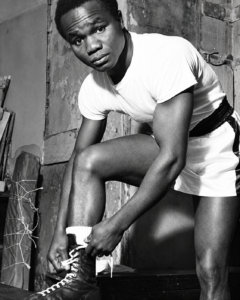
The world featherweight championship became vacant after Sandy Saddler’s retirement. Bassey’s opportunity came against Hamia, the French-Algerian contender, in Paris
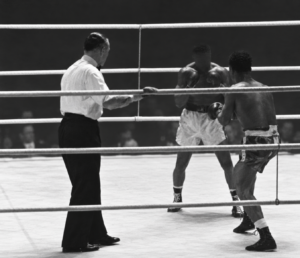
It was no effortless coronation. Archival footage shows Hamia knocking Bassey down before the Nigerian recovered and fought his way back into the contest. That reversal remains central to the story: the future champion first had to survive a moment when the fight might have escaped him.
By the tenth round, Bassey’s sustained attack had overwhelmed Hamia. Referee René Schemann stopped the contest, making Bassey the new world featherweight champion. An Associated Press account preserved by BoxRec described Hamia as unable to defend himself against the closing assault.
Bassey’s distinction must be stated accurately. He was Nigeria’s first world boxing champion. That specific achievement needs no inflated claim to establish its importance.
Proving Himself as Champion
Winning the championship was followed by the challenge of defending it.
On April 1, 1958, Bassey faced Mexico’s Ricardo “Pajarito” Moreno at Wrigley Field in Los Angeles. Moreno’s power made the contest dangerous, but Bassey stopped him in the third round. The United Press report preserved by BoxRec records a crowd of 20,034, evidence of the substantial international stage on which the Nigerian was now competing.
Recognition also came beyond the ring. The official 1958 New Year Honours supplement listed Bassey for appointment as a Member of the Order of the British Empire, recognizing his services to sport in Nigeria’s Eastern Region.
His championship reign ended on March 18, 1959, when American challenger Davey Moore defeated him in Los Angeles. Bassey lost their August rematch and subsequently retired from professional boxing.
Defeat closed his title reign. It could not undo the breakthrough.
A Career That Continued Through Others
Bassey later returned to Nigeria and worked in physical education and boxing coaching, helping prepare another generation of athletes. His influence therefore extended beyond the championship years into the less conspicuous work of instruction and development.
That second career deserves a place beside the famous victory. Sporting institutions depend on people who can pass on knowledge: how to prepare, how to respond under pressure, and how to sustain discipline when public attention moves elsewhere.
Bassey died in Lagos on 26 January 1998, aged 65.
A Career That Continued Through Others
Bassey later returned to Nigeria and worked in physical education and boxing coaching, helping prepare another generation of athletes. His influence therefore extended beyond the championship years into the less conspicuous work of instruction and development.
That second career deserves a place beside the famous victory. Sporting institutions depend on people who can pass on knowledge: how to prepare, how to respond under pressure, and how to sustain discipline when public attention shifts elsewhere.
What Remembering Him Should Mean

For Afribraz’s audiences across Africa, Brazil and the Caribbean, Bassey’s life offers a valuable perspective on sport, migration and national identity. His career shows how an athlete can build an international livelihood while becoming a reference point for people at home.
It also invites practical action. Boxing associations, schools, museums, publishers and sporting sponsors can preserve archival footage, document former champions’ careers and bring their stories into youth programmes. Historical recognition becomes more useful when it creates learning opportunities.
Remembering Bassey requires more than repeating that he was first. It means explaining where he came from, the professional journey that took him abroad, the opponents he defeated and the knowledge he later shared.
On that June night in Paris, Hogan “Kid” Bassey changed what a Nigerian boxer had achieved. The responsibility of later generations is to ensure that young people still know his name, and understand why it matters.
“A Tribute to Hogan ‘Kid’ Bassey”
Bassey’s name remains part of Nigeria’s physical and sporting landscape. At the University of Calabar, the Hogan Bassey Sports Pavilion continues to serve university activities.
In Lagos, his name appears on Hogan Bassey Crescent, while his gravesite at the National Stadium remains a place of sporting remembrance.
In March 2026, Nigeria Boxing Federation representatives joined boxers, coaches and supporters there to lay flowers in his honour.
These tributes show that his place in Nigerian boxing continues to be acknowledged beyond the historical record.
Sources:
liverpoolfootprint.co.uk, criticalpast.com, BoxRec, Nuga Unical