
An Exclusive Mid-Year Analysis by Afribraz Global Business Magazine
By the Afribraz Editorial Team
“Diplomacy opens doors, and Business creates opportunities. Investment transforms economies. The real measure of international relations is not the number of handshakes exchanged, but the value they create for people, businesses, and nations.”
Mid-Year Is the Right Time to Ask the Difficult Questions
At the halfway point of every year, we believe that governments review budgets, many companies evaluate performance, and investors and many businesses reassess strategies. As it goes, we also believe that Diplomacy should be no different.
As 2026 reaches its midpoint, Africa’s diplomatic missions in Brazil have every reason to celebrate important achievements. Political dialogue has intensified, high-level visits have become more frequent, cultural exchanges continue to flourish, and Brazil has reaffirmed its commitment to strengthening relations with African nations as part of its broader engagement with the Global South.
Yet diplomacy cannot be measured by ceremonies alone.
Behind every official photograph, bilateral meeting, and signed memorandum lies a more important question:
How much economic value has Africa’s diplomatic presence in Brazil generated?
Has the growing political goodwill translated into stronger trade?
Are Brazilian investors finding it easier to do business in Africa?
Are African exporters gaining greater access to Brazilian markets?
Have tourism, innovation, education, aviation, and technology partnerships expanded at the pace both sides envisioned?
These are not uncomfortable questions. They are necessary ones.
At Afribraz Global Business Magazine, we believe constructive assessment is essential to progress. This feature is not intended to rank countries, criticize diplomatic missions, or diminish the valuable work carried out daily by African embassies across Brazil. Rather, it seeks to evaluate a broader reality: whether Africa’s diplomatic presence is evolving into the kind of commercial diplomacy required in today’s highly competitive global economy.


A Relationship Built on More Than History
Few international relationships are as deeply rooted as that between Africa and Brazil.
Centuries of migration, cultural exchange, language, music, cuisine, religion, and shared historical experiences have created bonds unlike those between Brazil and any other region of the world.
Today, more than history connects the two sides of the Atlantic.
Brazil is home to the largest population of African descent outside the African continent. African traditions continue to shape Brazilian identity, while Brazil’s experience in tropical agriculture, renewable energy, aviation, public health, higher education, and industrial development offers valuable opportunities for cooperation with African nations.
At the same time, Africa has entered a period of profound transformation.
The continent is experiencing rapid urbanization, technological innovation, expanding consumer markets, infrastructure development, and deeper economic integration through the African Continental Free Trade Area (AfCFTA). With one of the world’s youngest populations and abundant natural resources, Africa is increasingly viewed not only as a region of future promise but also as a strategic partner for global business today.
These complementary strengths make the Africa–Brazil relationship more relevant than ever.
The question is no longer whether the partnership has potential.
It is whether that potential is being fully realized.
Beyond Political Friendship
Based on about 20 years of observations, we can assume that diplomatic relations between African countries and Brazil are by most measures stronger today than they have been in years.
We have noted that political dialogue has intensified, and that new cooperation agreements are now emerging; government delegations from some countries travel frequently between Brasília and African countries.
African embassies regularly take part in national events such as celebrations, investment seminars, academic conferences, cultural festivals, and multilateral discussions, and have ties with countries such as Ethiopia, Nigeria, and Ghana.
This re-engagement indicates a consensus that cooperation among nations in the Global South is more important with the changing landscape of globalization.
We need political trust to put our ground down.
But political trust in itself is not enough to create employment.
It does not boost exports.
It does not draw in investors.
It does not fill planes with business travelers.
It doesn’t attract tourists.
It does not provide funding for startups.
It does not facilitate the establishment of factories.
These results require more than trust.
It requires commercial diplomacy.
The new role of the modern embassy.
The image of diplomacy has changed greatly in the past two decades.
In the past, embassies dealt with political relations, protocol, visa services and consular assistance.
Those are still the essential responsibilities.
But today’s most successful diplomatic missions are expected to do much more.
In every corner of the world, embassies are increasingly serving as investment promotion agencies, export facilitators, innovation hubs, tourism marketers, academic connectors, and business development offices.
Modern ambassadors are called upon not only to represent their governments but also to create opportunities for entrepreneurs, investors, universities, airlines, technology companies, manufacturers, and exporters.
Economic diplomacy has become one of the defining responsibilities of twenty-first-century foreign policy.
African diplomatic missions in Brazil are part of this global evolution.
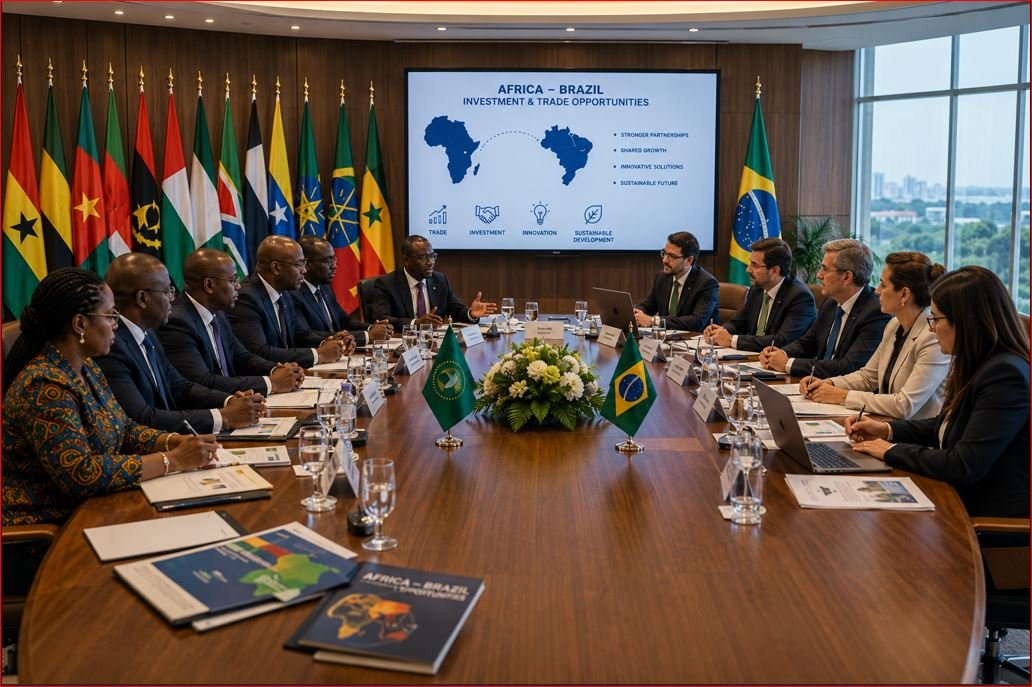
Many have expanded their commercial activities, organized business forums, supported trade delegations, helped promote investment opportunities, and developed more relationships with Brazilian institutions.
These efforts deserve recognition.
They demonstrate an understanding that diplomacy is now a matter not only of political power but also of economic power.
Brazil: An Opportunity That Extends Far Beyond South America.
For African countries seeking to diversify their international partnerships, Brazil holds a unique strategic position.
As Latin America’s largest economy and one of the world’s largest agricultural producers, Brazil has expertise that closely aligns with Africa’s development priorities.
Agriculture. Renewable energy, Biofuels, Mining, Civil aviation, Food processing, Healthcare, Education, Digital innovation, Infrastructure, Financial services, Sports management.
and Creative industries.
These are the areas in which we have practical cooperation that can generate long-term economic benefits.
Brazil is also a gateway to broader South American markets.
And Africa, too, offers huge opportunities for Brazilian companies looking to enter the world’s fastest-growing regions.
This relationship cannot be thought of as a donor-recipient relationship.
Nor as developed and developing.
It is increasingly a partnership between two regions whose strengths complement one another.
Signs of Progress Worth Celebrating
Any fair assessment must recognize the significant progress made in recent years.
African embassies have become more visible in Brazil’s business community.
Investment forums are occurring more frequently.
Universities have expanded academic cooperation.
Tourism promotion has really gained more attention.
Business councils and chambers of commerce have become more engaged.
Diaspora organizations are increasingly important in connecting entrepreneurs, professionals, and institutions across regions.
Several diplomatic missions have shown great creativity in promoting national investment opportunities, organizing trade missions, and supporting business networking initiatives.
These successes demonstrate that commercial diplomacy is not merely a theoretical concept.
It is already happening.
The challenge now is to scale these efforts and ensure they become the norm rather than the exception.
The Question That Defines the Second Half of 2026
However, one central question remains despite the progress.
Has Africa’s diplomatic footprint in Brazil grown at the same pace as its commercial footprint?
In other words, has stronger diplomacy translated into stronger business?
That question lies at the heart of this Afribraz Mid-Year Review.
In the next section of this exclusive analysis, Afribraz discusses where opportunities still remain underutilized, why commercial diplomacy must become the next frontier of Africa–Brazil relations, and how governments, embassies, the private sector, and the African diaspora can work together to turn goodwill into measurable economic results.
Because diplomacy may begin with dialogue, but its greatest success is measured by the prosperity it creates.
Publisher’s Note
Welcome to the Afribraz Mid-Year Review 2026, a four-part editorial series examining the evolving relationship between Africa and Brazil through the lenses of diplomacy, business, trade, investment, tourism, innovation, and international cooperation.
As Africa and Brazil deepen their engagement in an increasingly interconnected global economy, this series offers a balanced look at progress made in the first half of 2026, the challenges that remain, and the opportunities that could shape the future of one of the Global South’s most promising strategic partnerships.
Rather than ranking countries or criticizing institutions, this special report seeks to encourage constructive dialogue, celebrate successful initiatives, and highlight practical ideas that can strengthen commercial diplomacy and expand mutually beneficial cooperation.
At Afribraz Global Business Magazine, we believe that informed discussion is essential to meaningful progress. Our mission is not only to report developments but also to connect ideas, inspire partnerships, and help build stronger economic bridges between Africa and Brazil.
We invite diplomats, policymakers, business leaders, entrepreneurs, academics, members of the African diaspora, and our readers around the world to join this conversation as we explore the next chapter of Africa–Brazil relations.
This is Part I of a four-part special series.
IE.Aroh
Founder, Publisher & Editor-in-Chief
Afribraz Global Business Magazine