

Afribraz Global Business Magazine Feature
Introduction: A Narrow Passage Controlling a Wide World
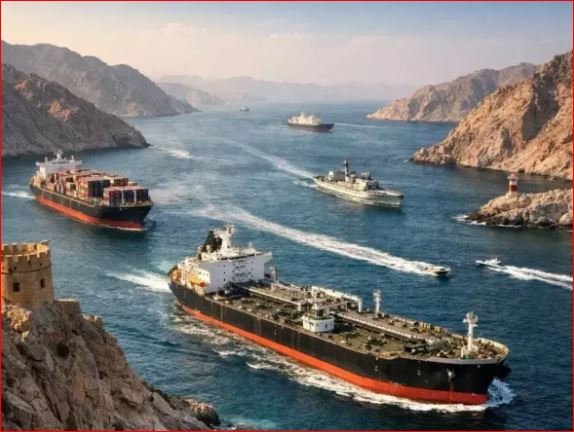
The Strait of Hormuz may appear as a narrow strip of water on the map, but in reality, it is one of the most powerful economic arteries on Earth. Every day, a significant portion of global energy supply flows through this passage, making it a cornerstone of modern civilization.
For investors, policymakers, and global business leaders, understanding this chokepoint is not optional – it is essential.
The Economic Lifeline of the Planet
The Strait links the Persian Gulf to the Gulf of Oman, acting as the export gateway for the world’s most oil-rich region.
Why is it indispensable:
* About one-fifth of global oil consumption passes through it
* It is the main export route for:
* Saudi Arabia
* Iraq
* Kuwait
* Qatar
* United Arab Emirates
Any disruption here doesn’t just affect oil—it impacts global inflation, transportation costs, manufacturing, and food prices.
Who Holds the Power? A Balance, Not Ownership
Although international law guarantees free passage, real control is shaped by geography and military presence.
- Iran sits on the northern edge, giving it strategic leverage
- The Islamic Revolutionary Guard Corps has the capabilities to disrupt shipping
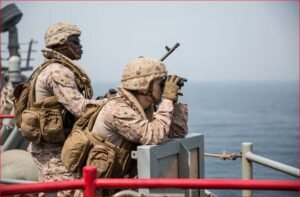
- The United States Navy patrols the region to secure maritime flow
– The result: a tense equilibrium where no single power fully controls the Strait, but several can influence it.
Why America Protects the Strait: Global Duty or Strategic Self-Interest?
This is the most debated question—and the answer is both.
1. Protecting Global Stability (The “World Favor” Argument)
The United States plays the role of a global maritime security guarantor.
- Ensures free flow of oil and gas
- Prevents supply shocks that could destabilize economies
- Supports allies in Europe and Asia
- Maintains order in a volatile region
Without a U.S. naval presence, the Strait could become far more unstable, affecting even countries far from the Middle East—including emerging economies in Africa and Latin America.
– In this sense, America is protecting the global economic system.
2. Protecting Its Own Strategic Interests (The Reality Check)
However, the U.S. is not acting out of charity.
Key self-interests include:
* Economic Influence:
Stable oil markets keep global trade predictable, which benefits American businesses and financial systems
* Geopolitical Dominance:
Control of key maritime routes reinforces U.S. global leadership
* Alliance Security:
Protecting partners like Japan, South Korea, and European nations that depend on Gulf energy
* Containing Rivals:
Limiting the strategic reach of Iran and balancing rising powers like China
– In reality, securing the Strait ensures that no rival power can dominate global energy flows.
Verdict: A Strategic Overlap
The U.S. protection of the Strait is not purely altruistic nor purely selfish.
It is a classic case of aligned interests:
- What benefits the world economy
-
Also benefits American power and prosperity Iran’s Strategic Leverage: Power Without Full Control
Iran does not “own” the Strait, but it can significantly disrupt it.
Its advantages:
* Strategic coastline along the waterway
* Naval asymmetry (fast boats, mines, missiles)
* Ability to create uncertainty in shipping
– This gives Iran a powerful bargaining chip in global politics:
the power to threaten, not necessarily to dominate.
Are There Alternatives to the Strait of Hormuz?
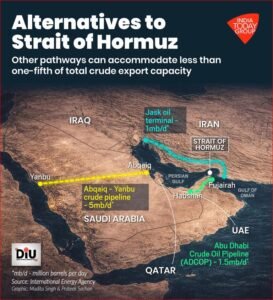
Despite its risks, the world has struggled to replace it.
Existing alternatives:
* Saudi East–West Pipeline → bypasses the Gulf to the Red Sea
* UAE pipeline to Fujairah → avoids the Strait partially
* Routes through the Suez Canal
Why they fall short:
* Limited capacity compared to tanker volumes
* High infrastructure costs
* Political and logistical constraints
– Bottom line:
No alternative currently matches the Strait’s scale, efficiency, and cost-effectiveness.
Implications for Africa and Emerging Markets
For regions like Africa—especially energy-importing nations—the Strait’s stability is crucial:
- Fuel prices are directly affected
- Transportation and food costs rise with disruptions
- Industrial growth becomes vulnerable
For oil-producing African countries, instability can mean price windfalls—but also market uncertainty.
Future Outlook: Will Its Power Decline?
The Strait will remain dominant in the near future, but long-term shifts may reduce its influence:
- Growth of renewable energy
- Diversification of supply chains
- Expansion of pipelines and storage hubs
- Strategic reserves by major economies
However, until oil dependency significantly declines, the Strait will remain a global pressure point.
Conclusion: The World’s Most Sensitive Economic Trigger
The Strait of Hormuz is more than a shipping route—it is a lever of global power.
- Iran can threaten it
- The United States protects it
- The world depends on it
And in this delicate balance lies a profound truth:
– Control of energy routes is control of the global economy.






Leave feedback about this